
Four-Legged Knot stitch is an isolated stitch which resembles an upright cross with a knot in the middle. If you work Four-Legged Knot stitch on a grid, you can build up patterns easily. The cross-like structure lends itself to patterned borders and bands. For a less formal and less rigid effect, you can sprinkle stitches across an area in a freeform manner. You can build them up one on top of another, stacking them irregularly in a hodgepodge of texture. It is simple and quick to work yet lends itself to experimentation. Four-Legged Knot stitch also lends itself to being worked in different weights and coloured threads and can be worked on plain and even-weave fabrics.
The size of the stitch varies according to the weight of the thread used, but it is effective on any scale. It is one of those versatile stitches that you can experiment with, large and small. Use it to couch down other fibres, arrange them in geometrical patterns or work in rows.
How to work Four-Legged Knot stitch
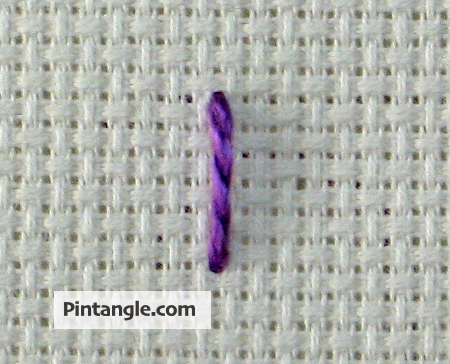
Make a vertical straight stitch.
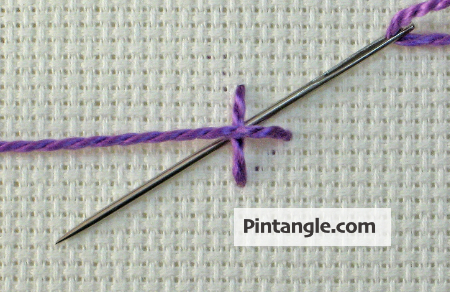
Bring your needle out to the right of the stitch and pass the needle under the stitch as illustrated.
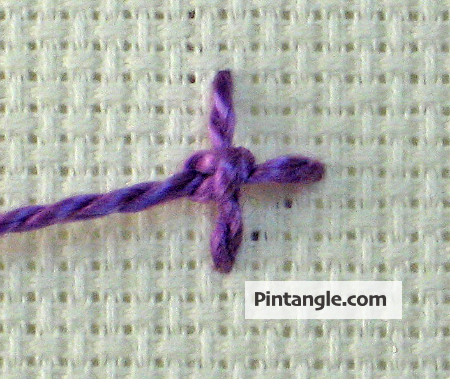
Loop the thread under the needle and pull the thread through to form the knot. The knot ties the stitch together and should not pick up any fabric.
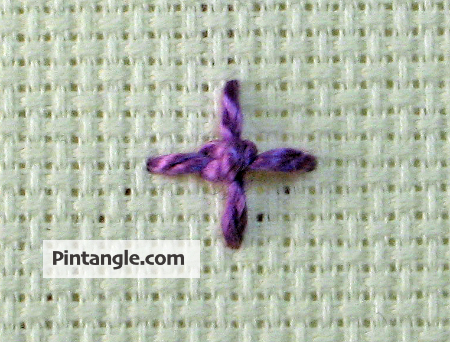
Take the thread to the back to complete the cross.
Work these crosses in a line, in a pattern or freeform; that is the fun of what hand embroiderers call an isolated stitch!
Thread Twisties!
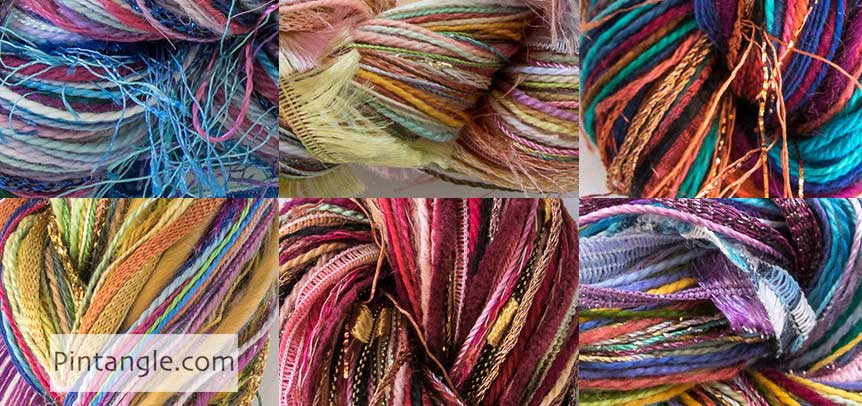
Experimenting with different threads can be expensive. You would normally have to buy a whole skein of each type of thread. My thread twisties are a combination of different threads to use in creative hand embroidery. These enable you to try out stitching with something other than stranded cotton. For the price of just a few skeins, you can experiment with a bundle of threads of luscious colours and many different textures.
These are creative embroiderers’ threads. With them, I hope to encourage you to experiment. Each Twistie is a thread bundle containing silk, cotton, rayon, and wool. Threads range from extra fine (the same thickness as 1 strand of embroidery floss) to chunky couchable textured yarns. All threads have a soft and manageable drape. Twisting them around a needle makes experimental hand embroidery an interesting journey rather than a battle. Many are hand-dyed by me. All are threads I use. You may find a similar thread twist, but no two are identical.
You will find my thread twisties in the Pintangle shop here.

I got my Thread Twisties yesterday and I love them. There are so many different kinds of threads that I am going to have a lot of fun using them…thank you…
I am pleased you enjoy them!