Take a Stitch Tuesday Stitch 66 Coral stitch

This week I have an easy quick stitch which I hope people will enjoy. Coral stitch is also known as coral knot, German knot stitch, knotted stitch, beaded stitch, and snail trail. It is also incorrectly known as scroll stitch which we looked at in TAST week 63. If you compare the two stitches you will see the needle is wrapped in a different manner producing a different look to the line.

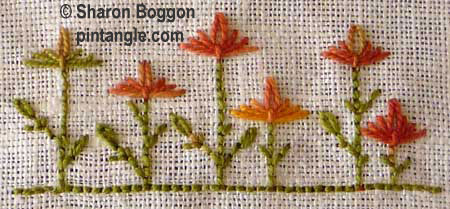
Coral stitch is an old embroidery stitch which creates a line that looks like a row of knots and is used for outlines as it follows a curved detail well.

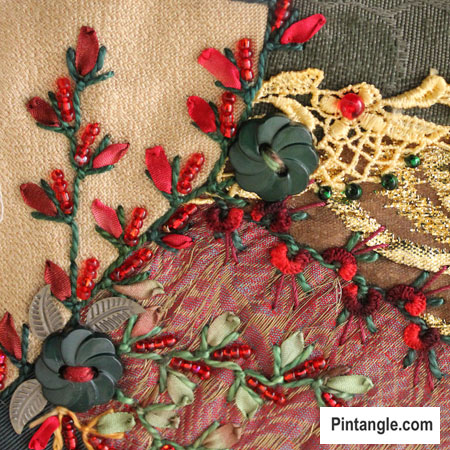
It is also a very useful stitch for twiggy bits in a floral design. If you work it in a very precise manner with knot spaced at exact intervals coral stitch can also be used to create a knotted filling with the knots forming a secondary pattern across the filling.

How to work Coral Stitch 

Coral stitch is worked from right to left. To work bring the thread up from the back of the fabric and hold it loosely on the surface of the fabric with your thumb.

Insert the needle at a slight right angle, above the line to be worked and bring it out just below the line to be worked and under the fabric that is laid flat to the fabric. Wrap the thread under the needle as illustrated.

Coral stitch step 1

Pull the needle through the fabric  to form a knot.

Coral stitch step 2Continue in this manner along the line.

Coral stitch step 3

Coral stitch can be varied by altering the angle of the needle as it passes through the fabric. Some people work this stitch with the needle entering the fabric in a vertical position as it passes through the fabric. This will produce a tighter knot.  By altering the spacing of the knots along the row the stitch can appear to be different.

The effect created is also altered by the weight and twist of the thread used. This sample was worked using perle # 5 cotton however experiment with threads as this stitch looks good worked in thicker threads or even a fine ribbon.

How to join in

It is not complicated. All you need to do is stitch a sample of this stitch or ANY of the stitches listed on the TAST FAQ page.

Once you have worked a sample,  photograph it and put it online at your blog, flickr etc then swing back to the Last TAST post (you will find it under the category each week)   and leave a comment that includes  your web address. When you leave a comment include the http:// part of the address as then your address becomes a link and readers will be able easily visit and see your sample. Remember you can leave a comment about any stitch you have worked as long as it is listed on the TAST FAQ page.

Any special rules?

There are no rules but I do have a request, please link back here.

Further information

If you need further information on the challenge a list of stitches covered so far or directions on how to participate please visit the TAST FAQ page.

You can read back through TAST articles by browsing Challenges -  Take a Stitch Tuesday category

Other groups and networks

You can also share your explorations with other members on the social network site of your choice. There is a Facebook TAST 2012 page,   stitchin fingers group and the flickr TAST site. All these sub groups are set up at request of members


Take a Stitch Tuesday Stitch 65 Buttonhole bar

hand embroidered buttonhole bar sample 1Buttonhole bar is often used in traditional pulled and drawn needlework and often seen used in combination with needle weaving. Used in a freeform manner it is fun and I find it highly addictive!

hand embroidered buttonhole barIt is also easier to sew than most people realise. The main trick is to keep your tension even, so stretch the fabric in an needlework hoop or frame while you work.

In order to work a buttonhole bar you need to know how to work buttonhole stitch so if you are beginner make sure you know basic buttonhole first.

Start with two or three horizontal straight stitches across the area you wish the bar to lay.

buttonhole bar step 1This forms the bar on which you sew.

buttonhole bar step  2Work from left to right. Bring the thread out on the lower left hand side of the straight stitches you have just created.

Work a buttonhole stitch over the bar of straight stitches. You do not pass the needle through the fabric, just under the bar.

buttonhole bar step  3As you work nudge the stitches long the bar so that they are snug but not so tight they twist the bar.

buttonhole bar step 4Take your needle to the back and secure it.

buttonhole bar step 5hand embroidered buttonhole barhand embroidered buttonhole barWhen you first learn this stitch use a thread such perle #8 or #5. When you have mastered it experiment with other threads. All sorts of threads can be used such as metallic, novelty or  textured threads.

Hand dyed multicoloured threads can also look interesting as with this type of thread the colour shifts along the bar.

Since it is important to sew the buttonhole stitches over the foundation threads without entering the fabric use a blunt ended needle such as a Tapestry needle of suitable size for the buttonhole stage of the stitch.

Online classes available

If you are enjoying this series of articles I regularly offer online classes. These are currently on offer.

Follow the links for further details, requirements list and to book a place. If you are not sure how an online class runs visit this page for a description of how classes are run online.

How to join in

It is not complicated. All you need to do is stitch a sample of this stitch or ANY of the stitches listed on the TAST FAQ page.

Once you have worked a sample,  photograph it and put it online at your blog, flickr etc then swing back to the Last TAST post (you will find it under the category each week)   and leave a comment that includes  your web address. When you leave a comment include the http:// part of the address as then your address becomes a link and readers will be able easily visit and see your sample. Remember you can leave a comment about any stitch you have worked as long as it is listed on the TAST FAQ page.

Any special rules?

There are no rules but I do have a request, please link back here.

Further information

If you need further information on the challenge a list of stitches covered so far or directions on how to participate please visit the TAST FAQ page.

You can read back through TAST articles by browsing Challenges -  Take a Stitch Tuesday category

Other groups and networks

You can also share your explorations with other members on the social network site of your choice. There is a Facebook TAST 2012 page,   stitchin fingers group and the flickr TAST site. All these sub groups are set up at request of members


Take a Stitch Tuesday Stitch 64 Top Knotted Buttonhole

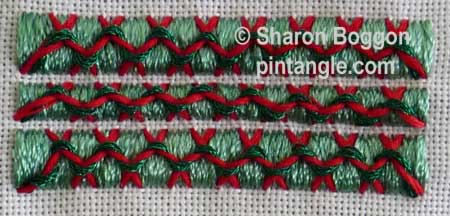
This stitch is a variety of buttonhole stitch which has a knot set at the top of each arm.

Instead of working it in a straight line you can vary the length of the arms to create patterns. You can use it as a couching stitch to hold down novelty threads. Since Top Knotted Buttonhole is a variety of buttonhole it works well as decorative edging stitch and holds curves well. When worked in a circle or around a large bead it makes a decorative little flower motif.

How to work top knotted buttonhole

top knotted buttonhole step 1This stitch is worked from left to right between two lines.

Bring your thread up on the bottom line and loop your thread around the needle as illustrated.

Insert the needle on the top line and nudge the knot down against the fabric. Angle your needle so that you can take a bite of the fabric with the needle point emerging on the bottom line.

top knotted buttonhole step 2With the thread under the needle as you would do in normal buttonhole stitch pull the needle through the fabric downward towards you to make the first stitch.

top knotted buttonhole step 3If you have trouble controlling the knot at this stage place your left thumb and hold your half formed stitch between thumb and forefinger as you pull the thread through.

top knotted buttonhole step 4Continue in this manner along the line.

This sample was worked using perle # 5 cotton however experiment with threads as this stitch looks good worked in thicker threads or even a fine ribbon.

If you are enjoying this series of articles I regularly offer online classes. These are currently on offer.

Follow the links for further details, requirements list and to book a place. If you are not sure how an online class runs visit this page for a description of how classes are run online.

How to join in TAST

It is not complicated. All you need to do is stitch a sample of this stitch or ANY of the stitches listed on the TAST FAQ page.

Once you have worked a sample,  photograph it and put it online at your blog, flickr etc then swing back to the Last TAST post (you will find it under the category each week)   and leave a comment that includes  your web address. When you leave a comment include the http:// part of the address as then your address becomes a link and readers will be able easily visit and see your sample. Remember you can leave a comment about any stitch you have worked as long as it is listed on the TAST FAQ page.

Any special rules?

There are no rules but I do have a request, please link back here.

Further information

If you need further information on the challenge a list of stitches covered so far or directions on how to participate please visit the TAST FAQ page.

You can read back through TAST articles by browsing Challenges -  Take a Stitch Tuesday category

Other groups and networks

You can also share your explorations with other members on the social network site of your choice. There is a Facebook TAST 2012 page,   stitchin fingers group and the flickr TAST site. All these sub groups are set up at request of members


Take a Stitch Tuesday Stitch 63 Scroll Stitch

This week the stitch for the Take a Stitch Tuesday Challenge is a stitch that is often forgotten and not often used. This week I encourage you to experiment with Scroll stitch. At first glance it does not look too exciting but it is one of those stitches where using different threads creates all sorts of interesting effects from a braid like stitch to a line of spaced knots.

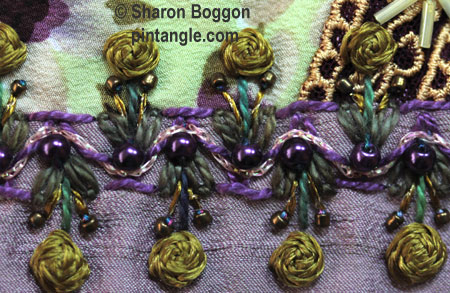
Scroll stitch sampleYou can work it on a tight curve and looks good when used to define a disk. As you can see in the sample above I worked a series of scallops on my latest crazy quilt block

Scroll stitch can be worked back to back to produce a heavy line or even lines stacked one against the other. This is particularly successful if you use a variegated or hand dyed thread because it can produce interesting texture and colour shifts.

Scroll stitch is also known as single knotted line stitch.

Scroll stitch instructions step 1Work scroll stitch from left to right along the line.

Bring your needle out of the fabric on the left, move along the line slightly and insert your needle on the line in a diagonal position pointing left taking a small bit of the fabric.

Scroll stitch instructions step 2With the thread wrapped behind and under the needle, pull through the fabric. As you work along the line do not pull the loop too tightly.

Scroll stitch instructions step 3This sample was worked using perle # 5 cotton however experiment with threads as this stitch looks good worked in thicker threads or even a fine ribbon.

Novelty threads often work well with this stitch so do experiment a bit.

Online Classes currently available

If you are enjoying this series of articles I regularly offer online classes. These are currently on offer.

The Artists Studio Journal: A Designers Workhorse will start May 22nd 2013.

Sumptuous Surface Embroidery will start on 12th June 2013.

Follow the links for further details, requirements list and to book a place. If you are not sure how an online class runs visit this page for a description of how classes are run online.

How to join in

It is not complicated. All you need to do is stitch a sample of this stitch or ANY of the stitches listed on the TAST FAQ page.

Once you have worked a sample,  photograph it and put it online at your blog, flickr etc then swing back to the Last TAST post (you will find it under the category each week)   and leave a comment that includes  your web address. When you leave a comment include the http:// part of the address as then your address becomes a link and readers will be able easily visit and see your sample. Remember you can leave a comment about any stitch you have worked as long as it is listed on the TAST FAQ page.

Any special rules to this challenge?

There are no rules but I do have a request, please link back here.

Further information about TAST (Take a Stitch Tuesday) 

If you need further information on the challenge a list of stitches covered so far or directions on how to participate please visit the TAST FAQ page. You can read back through TAST articles by browsing Challenges -  Take a Stitch Tuesday category

Other TAST groups and networks

You can also share your explorations with other members on the social network site of your choice. There is a Facebook TAST 2012 page,   stitchin fingers group and the flickr TAST site. All these sub groups are set up at request of members.