
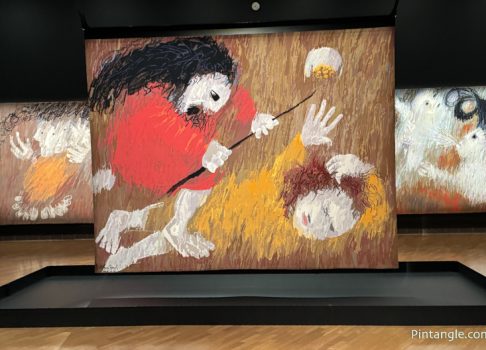
As I walked around the Arthur Boyd Tapestries currently being exhibited at the National Gallery of Australia I found myself leaning in closer than I probably should hoping that I would not trip security alarms. There is something magic about seeing textiles in a gallery when you are a textile artist yourself. You don’t just look at the finished image. You have a real sticky beak at how it was made.
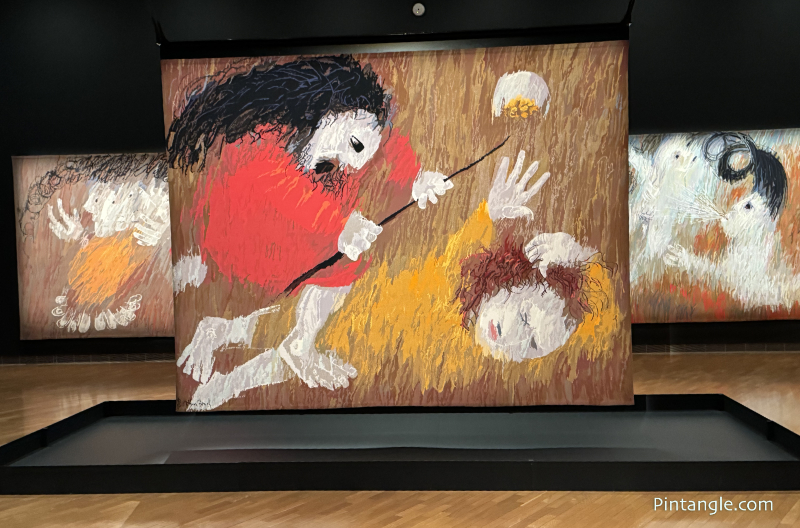
I was constantly looking at the surface, following a line to see how it has been constructed, and how the maker solved a particular problem. I was looking at the decisions behind the finished piece.
For the first time, all 20 tapestries in Boyd’s Life of St Francis series are being shown together. Each enormous tapestry measures approximately 2.5 by 3.4 metres, and together they fill the gallery with Boyd’s strange, expressive and sometimes unsettling interpretation of the life of St Francis of Assisi.
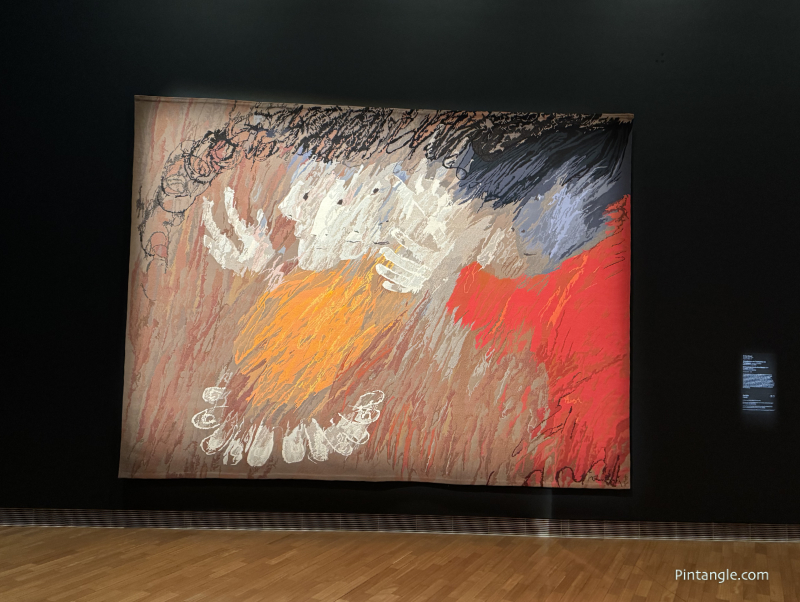
For someone who loves textiles, however, there is another story unfolding here – the story of how a drawing becomes cloth. Arthur Boyd (1920–1999) was one of Australia’s most important artists. He worked across painting, drawing, printmaking and ceramics and came from the remarkable Boyd family of artists and makers.
Arthur Boyd and St Francis
Boyd had a long fascination with religious, mythological and literary stories. His interest in St Francis began appearing in his work in the 1940s and 1950s. It was after a visit to Italy in 1964 that St Francis became the focus of a much more sustained body of work.
St Francis is associated with compassion, poverty, spirituality and a profound connection with nature. Boyd’s interest was about more than simply illustrating the life of a saint as there is a personal story running through the work too. The relationship between Francis and his father resonated with Boyd’s own complicated relationship with his father. In the story of St Francis, the young Francis rejects his wealthy father’s way of life and gives away his possessions, including his father’s cloth.
The tapestries aren’t simply illustrations of a medieval religious story. Boyd was using the story to explore human relationships, spirituality, conflict and emotion. The images felt dream-like to me – something caught and captured that were on the edge of your imagination.
From Drawing to Tapestry
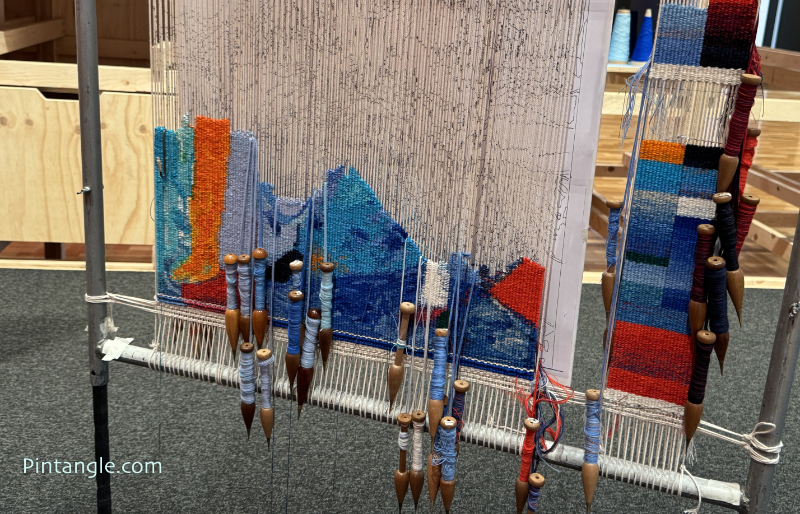
As you enter the exhibition and before you see the monumental tapestries, you encounter a huge installation of video depicting weavers hands adding stitches to loom – stitch by stitch. In the same room there are some of the lithographs that helped Boyd develop his ideas. As the exhibition continues through the galleries drawings and pastels are also on display. The drawings are lively and exploratory. Some are little more than a few marks on paper. Others are more developed studies. You can see Boyd trying things out, following an idea and then abandoning it. I really enjoyed this aspect of the exhibition because it reminds us that artists rarely arrive at a finished image fully formed. There is always experimentation, exploration, and false starts. There are drawings that lead somewhere and drawings that don’t.
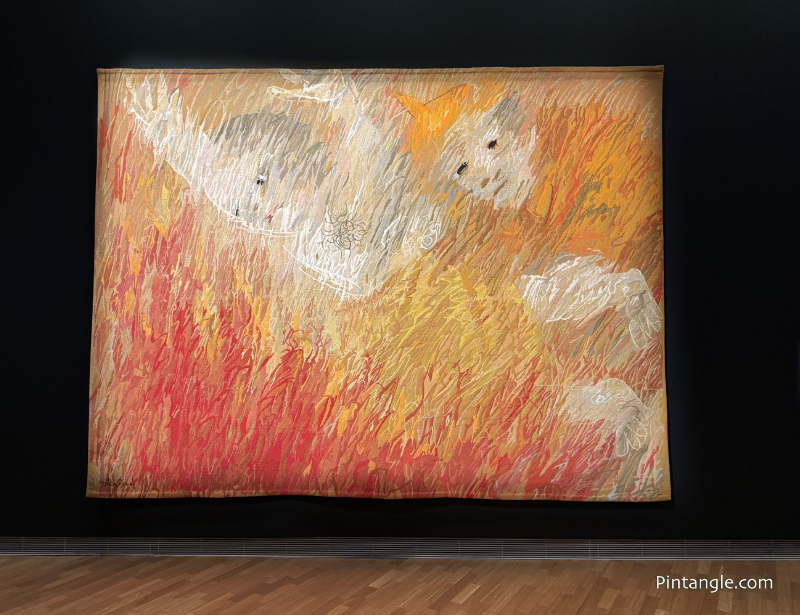
The National Gallery has included drawings from the Arthur Boyd Gift alongside the tapestries, allowing visitors to see some of this process of working through an idea. And then there is another, very different type of drawing that I appreciated seeing- the weaving cartoon. These are working documents made by the Manufactura de Tapeçarias de Portalegre in Portugal. A photographic transparency of Boyd’s source image was projected onto paper and the principal elements of the composition were drawn by hand. Instead of simply painting the colours onto the cartoon, the wool colours were indicated by numbers. The cartoon was then cut into horizontal strips and attached to the vertical warp of the loom, giving the weavers a guide as they worked. Including these working cartoons in the Arthur Boyd Tapestries Exhibition makes the translation from drawing to textile much more visible so that visitors to the exhibition understood that the process was not a simple “copying” of a picture. There is interpretation at every stage.
Millions of stitches
The scale of the finished works is astonishing. Each tapestry contains between approximately 4 and 8.5 million stitches. As someone who works with embroidery, I know what it means to repeat a small action hundreds or thousands of times. So the thought of producing millions of stitches to create a single enormous image is almost overwhelming.
And yet, when you stand back, you don’t see millions of stitches. You see Boyd’s image.
There is something especially satisfying about discovering that the exhibition doesn’t simply finish when you leave the gallery containing the tapestries. Outside the exhibition is The Weavers’ Studio, a free, drop-in hands-on space created in partnership with the Australian Tapestry Workshop.
After spending so long looking at millions of stitches, it is rather humbling to sit down in front of a simple loom and start weaving for yourself. The studio invites visitors to experiment with colour, texture and pattern using simple looms. It is designed for everyone, from complete beginners to more experienced weavers, and children and families can join in too.
And then you encounter the weavers studio
I particularly like this idea as the final part of the Arthur Boyd Tapestries exhibition experience. You have just spent time looking at enormous, highly sophisticated works created by artists and master weavers. Then you have the opportunity to sit down and make a mark yourself. Suddenly, weaving is no longer something happening behind glass or in a photograph of a distant Portuguese workshop. You are handling the threads. You are deciding where the colour goes. You are learning, in a very small way, how the warp and weft interact. Perhaps that changes the way you look back at the tapestries.
That is what I took away from this exhibition. Not just the extraordinary scale of Arthur Boyd’s vision, or the story of St Francis, or even the technical achievement of the Portuguese weavers. It was the journey from idea to drawing, drawing to cartoon, cartoon to weaving, and weaving to finished artwork. As textile artists, we spend a lot of time thinking about stitches. We think about the right thread, the right fabric, the direction of a stitch and what happens when one small mark is placed beside another. Arthur Boyd’s tapestries take those same fundamental ideas and expand them to an almost unimaginable scale.
I went to the National Gallery to see Arthur Boyd. I came away thinking about thread, drawing, collaboration and the extraordinary things that can happen when an image is allowed to become textile. And I rather liked ending the visit by sitting down at a loom and making a few stitches of my own.
Arthur Boyd Tapestries Exhibition Details
June 20, 2026 – October 18, 2026 at the National Gallery of Australia, Canberra
Free Admission
The NGA website
For more information about Arthur Boyd see the Wikipedea entry here
Or
the video on the NGA site
My New Book: Creative Stitches Volume 2 — Now Available
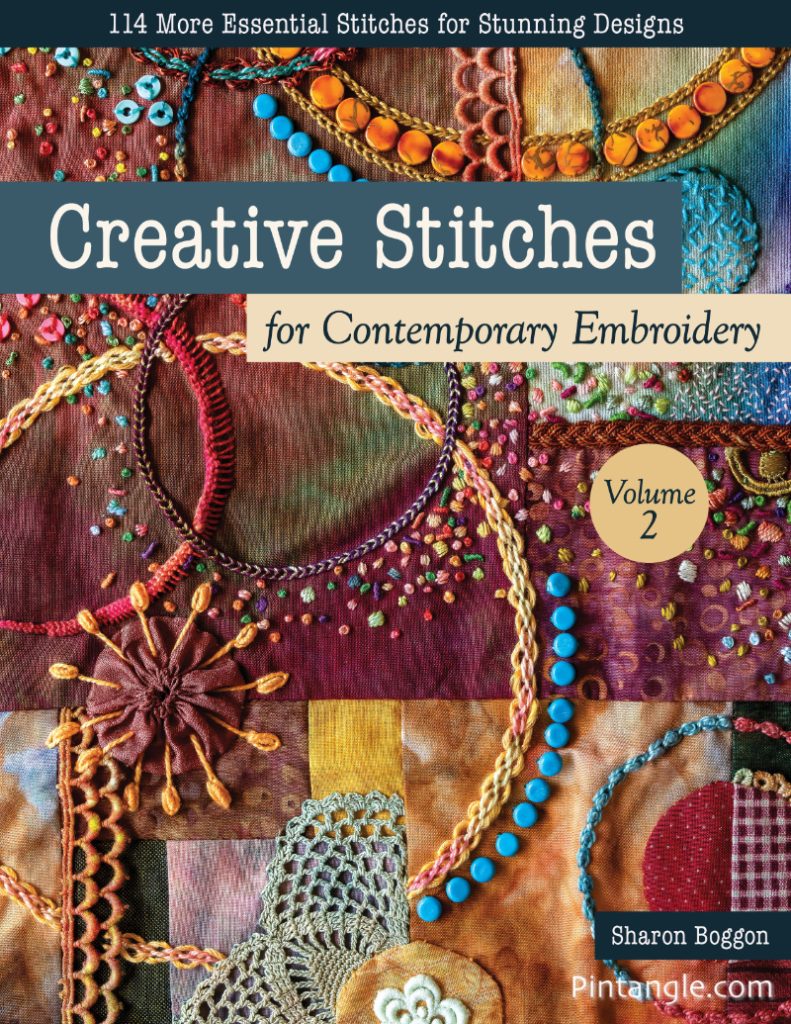
Explore a further 114 NEW hand embroidery stitches with clear, step-by-step photos, and practical, straightforward instructions for both left and right-handed stitchers! Try out inventive techniques, and gain confidence to play with stitches. Experiment with stitches and apply them to your own contemporary designs. My book is perfect for anyone who loves hand embroidery, crazy quilting, or slow stitching. And I have included loads of photos to inspire your creative journey.

Thank you very much Sharon for sharing your thoughts and experiences of the exhibition. I am very ignorant of Australian artists beyond the embroidery aspects so it was good to appreciate the work processes that brought Boyd’s ideas to fruition. Too far for me to ever travel in my lifetime so a truly on-line inspiration.
Thanks June I am pleased I was able to share it with you
I really enjoyed this post. It reminded me of my visit to a museum in Auckland; I don’t recall if it was NZ’s national museum, but the theme of the special exhibition was “Threads”, a history of fiber arts in Zealand. We were only given a couple of hours to explore, so I immediately broke away from myy group and headed for the quilts. The first was a room of scrap quilts by early settlers and later examples of crazy quilting. I felt I was heading for overwhelm, but the next gallery overtook me. I was alone in this space and totally awestruck by the contemporary art quilts of Nancy Crow, an American fiber artist , whose work was familiar to me. But here I was seeing her creations in the cloth — it was spiritual! I had to linger, then forced to practically run through other galleries of weaving, stitching. etc. Sadly I missed the exhibits on Maori culture altogether.
https://www.flickr.com/photos/playswithfibers/albums/72157600240813111/with/508362164
Sounds a very interesting exhibition – I like Nancy Crows stuff too
A thought provoking commentary.
Thank you
Regards
Kim
Thanks Kim
Thank you for this lovely article.
This was wonderful and I learned a lot, Sharon. Thank you! Wish I could come and see it!
Thanks Barb it is a good exhibition