
Hi all I have just approved numerous comments. Some not nice 🙁 . Don’t fret I am shaking my head and laughing but I had better clarify before I cop too much more flack.
I want to make it very clear that the type of projects I am objecting to are those that promise things like “make last minute gift in 15 minutes”. I saw this on a news stand in the supermarket. In Oz the mags are housed near the check out, so you pick them up while waiting in line. This “thoughtful” project advocated buying particular materials and gluing on this and that to produce something that was simply awful. I wondered what was the point and an even more serious question popped into my head. Where does this philosophy take craft?
I am not talking about a machine embroidery/quilting versus hand embroidery. I am talking about a multi million hobby industry that promises skill, design sense and a meaningful project without you having to invest time or emotional commitment. Any skill takes time to develop and the thing about craft work is that it is skillful. No matter if its made using a sewing machine or by hand the item has taken time, skill and thought to make it! That is the opposite of what is being promised in these 15 minute gift problem solvers!
Another category of people who need to consider their time are those studio based artists who earn a living from their work. They need to produce a certain amount of things in order to survive and obviously items like sewing machines are used. Since people are working from a studio professionally hopefully these items are constructed with skill, consideration and thought.
OK so what to me is a slow craft or slow cloth? To me it matters not a jot if its hand or machine made but what matters is that the process is thought through in a considered manner. Short cuts are not taken because of time constraints. This involves an acceptance of the inherent nature of the process, understanding materials and accepting that some things simply take time to make and that is what makes them so valuable.
Skills take time to develop and accepting that the reason a skill is valued is because of the time it has taken to be mastered. You can’t simply buy it or take a class then have it at your finger tips. A skill has to be developed and used to be by definition a skill.
I have been thinking about the definition of a Slow Cloth and Art Cloth given in Red Thread Studio. I differ a little. For me a slow cloth and an art cloth are often the same as it can fall into the traditional side of textiles or it can be contemporary. For instance I see Judes work often featured in Spirit Cloth as being contemporary art quilting but also a slow cloth because not only is there a complete acceptance of process but the object produced is very much tied to identity. Simply put it has meaning.
For me although the global textile traditions and techniques, the ethnography of textiles do fall into the idea of a slow cloth so do our own traditions such as for instance needlework samplers and quilting traditions. In many way the shift between traditional textiles and art cloth is simply a cultural time line because what drives their making, their cultural and personal significance is similar. Both are not about instant gratification and therefore are to me a slow cloth.
Do read the responses on the comments on yesterdays post as they are all very thoughtful and considered. Deb of Just enough Time has written about her ideas in her blog. Heather of True Stitches touched on some ideas here
Jocelyn in response to my question “do you think we need a craft philosophy that celebrates the hand crafted object made with care and meaning without regard to time” asks “Do you mean an actual organised movement that celebrates slow work?” That got me thinking as we would first have to define a slow cloth. As Jocelyn points out many textile practitioners already create within this philosophy without realising it and feel guilty that they only manage to do what they do. They feel guilty that they can not make things quickly and stupid if they can not stitch like someone who has been stitching for 20 – 30 years. I would like to find a term that allows people to ditch these feelings and simply get on with the process guilt free.
I am wondering if in searching for a definition we might be able to think about the process clearer. It might give us the ability to talk about it and tease out some of the issues around contemporary craft practice. What do you think? Do we need a discussion about the term – if so how would you define slow craft or slow cloth? Do we need to formalise a philosophy and in turn a group? I am not sure. How might this be done? Taliking about it is the first step.
Leave a comment or write a post on your blog (let me know if you do) I would love to know what people think about these ideas. For me, I am interested in questioning the ‘have it done in a snap’ culture that seems to be growing. I don’t think it’s good for the long term life of any of the craft areas which is why I am asking the question.
Thread Twisties!
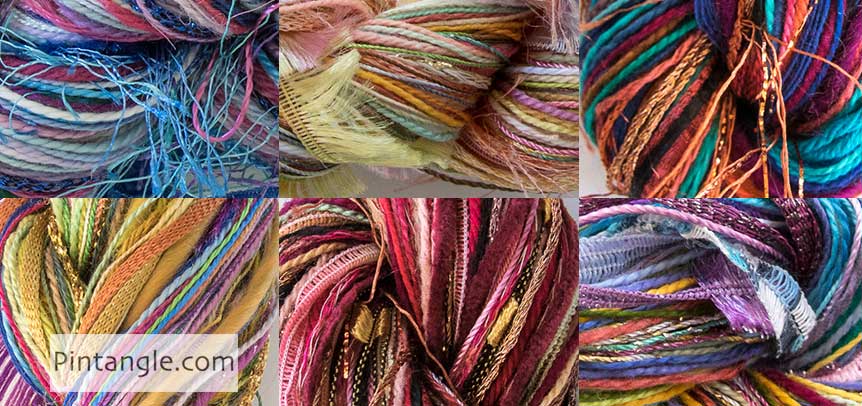
Experimenting with different threads can be expensive. You would normally have to buy a whole skein of each type of thread. My thread twisties are a combination of different threads to use in creative hand embroidery. These enable you to try out stitching with something other than stranded cotton. For the price of just a few skeins, you can experiment with a bundle of threads of luscious colours and many different textures.
These are creative embroiderers’ threads. With them, I hope to encourage you to experiment. Each Twistie is a thread bundle containing silk, cotton, rayon, and wool. Threads range from extra fine (the same thickness as 1 strand of embroidery floss) to chunky couchable textured yarns. All threads have a soft and manageable drape. Twisting them around a needle makes experimental hand embroidery an interesting journey rather than a battle. Many are hand-dyed by me. All are threads I use. You may find a similar thread twist, but no two are identical.
You will find my thread twisties in the Pintangle shop here.

Slow cloth – considered cloth?
This idea of slow cloth is very good. As some have said, sometimes definitions can get too restrictive which can be a problem but on the whole it’s a valuable idea and I’d love to have a button. I have never had the money to buy a lot of the expensive “in” stuff. I knit with a lot of good old Red Heart knitting worsted as it’s a case of knit with the cheap stuff or don’t knit at all. So, as I have done all my life, I take the basic stuff and do my best to make something great with it. Am I making heirlooms? Not often but what I make I am proud to wear or give as gifts and they usually take more time than if I had all the “right” stuff.
I visited a store to buy fancy papers that were on sale to find the price still high and realized I could make my own. I went home with none and have since made several handmade background papers.
So, slowcloth applies to slowpaper, slowknits and on and on. I think it’s a great concept for today’s rushing world. A word that means to take time and effort with ones talents for both enjoyment of the process and to create something worthwhile. Slowcloth. Yes. Send me the button!
What a wonderful conversation I have stumbled into! I am both a hand advocate and a machine guru! Working in a quilt shop for 12 years required me to “pump out” samples as the new fabrics/patterns came in. Now a stay at home quilter/designer/teacher, I can take the time and do things the ways in which I am comfortable
and feel most rewarded. Sometimes that means machine applique and sometimes it means hand applique, sometimes machine quilting and sometimes hand quilting…it varies for me with each project. I am about to journey into my first crazy next year and am very excited at the prospect of all that wonderful handwork with all the marvelous embellishments I have spent the last year acquiring.
As a machine quilter who does commission work on my little ol’ Bernina…I do wonder somtimes how much satisfaction a person can get doing thier 10th Yellow Brick Road or Turning Twenty quilt. I can’t imagine doing any quilt twice let alone one that does not allow me to use much creativity or imagination.
I’m conflicted on this issue.
I’m a weaver so I make cloth slowly. I know how to spin so I can make yarn and thread – slower than purchasing it. I am a quilter and I love to design patchwork baby blankets that I have quilted slowly by hand. Felting is a sometimes love. I have felted with a single needle, a punching machine, by hand and using a washing machine – I’ve even driven my car back and forth to complete a very large felting project. I like to do stitched beading projects. I enjoy dyeing fabric and yarn with natural materials.
But….
I have a computer and I do digital artwork and scrapbooking. I use my serger and my sewing machine endlessly. I make collages of paper and fabric with pots of glue, paint and found objects. I fuse fabric when I do quick little journal quilts and postcards and ATCs.
I like to finish projects in a reasonable time but I also enjoy those that take some time and allow my mind the freedom to wander while my hands work automatically.
Efficiency comes into play when I’m doing repetitive processes – like turning out a pile of holiday cards to get them in the mail before the year rolls over.
Boredom drives me, I guess, to try new things and collect new skills and tools. Sometimes I get so many ideas, I feel like I have to work faster to keep up. It’s the “doing” that’s important. So it matters not whether I’m working fast or slow or how long a project takes.
I have a bit of a different response on my blog: http://debraspincicdesignstudio.blogspot.com/2007/12/when-opportunities-arise.html
Hi Sharon, I included some thoughts on “slow cloth” on my blog entry for this week’s PLOS class. Cheers Mara
I’ve been thinking this over ever since reading these various posts and comments that have been surfacing. To me it seems like many people in the culture I’m familiar have taken up certain ideas or critera and measure all things they encounter by asking, is it useful/practical? and does it work and/or will it sell? And additionally their time frame for judging this is often the “dead-ahead”, short turnaround without a glance at the ripples and the long term. At this level I think many would rule out slow cloth because it doesn’t meet their critera. Some seem willing to say, it might not be practical but if it meets some inner need in the person then for them it is useful.
Will these ideas lose their grip or be agumented by others in my culture? I’m not sure, perhaps when dissatifaction and insightful dialogue takes place. When changes to other significant conditions in the culture take place, there may be a shift.
I feel sure that I don’t see the whole picture clearly, but this discussion makes me want to study and gain a better understanding of the issues involved. Thanks for bringing it up, Sharon. I’ve enjoyed all the discussion.
Valquiria, Sharon, I left a note on Valquiria’s blog but in case you don’t see it, the tiny little Chinese characters that are written below the second picture that Valquiria posted on her blog (the photo on the right hand side) call the stitch “Corn Stitch”. I will post a proper response about slow cloth later. Cheers Mara
Paula please leave a URL for your posts so that others can read them too – it seems a pity to be teasing out such interesting ideas and not leaving a URL
for everyone this is Paulas site
http://paulahewitt.wordpress.com/
I’ve written another post on art and craft, which you may be interested in. I think I have a few more in me before I get it all out of my system!
These are fantastic responses and well worth pondering on further. It’s not the last post I have made on this as I am reading, thinking and developing ideas.
Much of what I am thinking about applies to craft and how it has been devalued over the years and how younger crafters are redefining it and subverting the older use of the term. I will be talking more about the relationship of the maker to the object and time just give me a little time to respond.
Keep the comments up as I think its a discussion really worth having
Oh, and I just bought a serger after 30 years of sewing by hand and on a regular machine. What kind of crazy contradiction is that to my values? I’m looking at it as a tool that will reduce the time spent on some mundane aspects of production work, allowing more time for design and hand worked details. I’ll let you know if that works or not!
Great comments from everyone. I want to spend a little more time thinking about all of this, but wanted to say that I don’t think the quickie 15 minute projects necessarily are a positive introduction to craft. My first knitting project was an intarsia sweater – a real challenge, but I really WANTED to make it. The desire to see the finished project helped get me through the frustrations and the project took long enough that I learned to relax and enjoy the knitting. So when I’m teaching someone I encourage them to choose something they really are excited by, regardless of skill level (to a point.)
Sharon, You’ve touched on something that I”ve felt, but been unable to put into words. I’m dismayed by the commercial craft “engine” that churns out insta-kits to create a furor over the lastest creative product. There is a huge emptiness in these mechanically perfected final pieces.
As well, too many of my friends denigrate what they create because it’s not “perfect” – and don’t allow themselves those epiphanies that come from discovering something great when straying from the instructions whether by design or chance.
Though I am not at all a fan of “quick” crafts I think I am even less enamored of overly detailed and/or rigorous compartmentalization. It is undoubtedly helpful for most of us to get more focused and clear on out goals but I believe too much emphasis upon ‘movements” of whatever kind will inevitably distract and thus hinder the energy of essential creative spirit.
A small example of what I mean that is purely personal: In the late 80’s I started creating smallish projects that I referred to as journal quilts because that’s exactly what they were. I worked on these until a protracted illness obliged me to put all such projects on a long-term hold. Year before last, when I hooked into the blogosphere for creative endeavors, I discovered that “journal quilts” had become a very tightly defined form of stitching endeavor. Have since, under show and tell conditions, had more than one person tell me (quite adamantly and in terms that clearly seek to ‘educate’ me) that what I created years ago were not in any way shape of form “journal quilts”. Which is patently ridiculous in the creative aspects – it only makes sense or holds relevance if one is inclined to cleave unto widely established parameters that would suggest a rose IS NOT a rose, CANNOT BE a rose, etc.
More broadly, I see the same kind of thing happening all the time with the term “art quilt”. Quite frankly there are any numbe of pieces that I see labeled as such that really don’t seem like they are anything more or less than ‘technique samples.’
I suppose what I’m really saying is that I believe words, and the definitions they form, can be as great of a failure as they are an undeniable sorting and containing boon to our collective consciousness. I absolutely love the idea of slow cloth but feel instinctively apprehensive about the labeling aspects. So I don’t know if I personally would embrace/display a button kind of identifier even though I’d be instinctively drawn to the idea and what it conveys to me about the statement it makes.
Ironically it is taking me forever to type this because on Friday I was working on machine quilting a covelet so that I could have it done in plenty of time to provide an extra bedcover for holiday guests. The more I got into the rhythm of the thing (which is admittedly against my organic preferences for how I produce a completed quilt or much of anything else beyond pot holders etc.) the more I focused on speed and saving time than overall mindfulness. And thus I wound up sewing through my left index finger. Not only will my ‘fast’ project wind up taking a lot longer on the clock than I intended, I have had not choice but to slow ALL the way down and take some pure thinking time before I’ll be able to comfortably ‘make’ anything at all – by fast OR slow methodology.
I am not sure if I am making sense to you as I am not really taking exception with anything you may intend to convey or have serving as the basis on which people respond. It’s just the human tendency/need to categorize and define that I question and I *do*, more often than not, question that very strongly. The human tendency serves its purpose to be sure but I really am not clear on how wide a swatch that purpose can effectively cut in matters related to authentic creativity, art, and/or *mindful* craft of any kind – simply because there will always been those who apply the definition for matters of regimentation and thus, some form or another of cookie cutter mentality. And unfortunately that will always hold enormous sway for those who are inclined to develop their talents by way of seeking out how-to guidelines that outline exactly how they are “supposed” to accomplish their goals.
That saddens me greatly and, as I said at the beginning of my remarks, I also feel quite strongly that it’s spirit-killing at a collective level.
Hi Sharon
Thanks for your answer.It’s true,when it was worked in singles they look like buds.Well,I think I’m call it bud stitch for now on.
Sharon,this topic is fantastic.I’m seeing much of the brazilian market in your words.The people don’t realized that.The brazilian artisans,many of them, are cheated for the industry,my students wants learn only this 15 minutes projects,this insane.It’s no art.It’s foolish!
These are my thoughts
Valquiria
I am so glad this discussion is taking place. I’m continuing to think about it and will have some more response on my blog. It really fits into the theme of my blog,Just Enough Time, because I am totally an advocate of slow cloth and I believe there IS enough time for it. However, I do believe there are times and places for quick, but with the integrity of well and properly done, also. Machines are great, as long as the technique is well-done and well-considered, not just fast.
I was really saddened by Badger’s comment, because it has been such a joy for me to have been able to be stitching by hand since I was really little, starting with embroidered dish towels and pillow cases.
I think maybe more of us who know how to do these things need to make ourselves available to teach others. I am always amazed to see how many young women want to learn how to hand piece and quilt when they learn I know how to do it…. Don’t want to take up too much space. Check my blog in the next day or so for more musings.
http://justenoughtime.wordpress.com
Deb
Hi Valquiria I have checked out your blog and tried to leave a comment but I m not sure if it got through so I will answer here too in the hope it gets to you.
I have seen this stitch before but never published. I have only seen it being worked once and the lady who showed it to me called it bud stitch because when it was worked in singles they look like buds – I have hunch I have seen it elsewhere but I have no idea if this is actually the right name for the stitch.
Badger in response to “but what about the people who have had no experience of embroidery and textiles at home or school when growing up who become involved by starting with these 15 minute projects?”
I feel they are being cheated of a meaningful experience because the industry is marketing the idea of a meaningful experience in creating something but is not actually giving them the information to enable them to do it. They are selling them products to make things lots of doodads and tools but that is it – they end up spending money on new hobby but the interest does not last and they move on to the next fad because they are never satisfied with what they make. Because they do not know a lot about it they are being preyed upon and what is worse often feel it is their fault. That is what worries me as I think many who start this way do not have the best introduction to what can be an extremely meaningful experience.
Thankyou for your response because it is an important question and I think one of the key reasons why I think it is worth discussing and keeping the topic active. Many of those who hop from quick project to quick project may find that delving a little deeper is more satisfactory if they were exposed to what many have already discovered but assume it does not need to be said.
Great discussion and topic and Red Thread is a great addition to the blogging world re fiber arts. As a foodie and art cloth/art quilt maker (yea though I DO use sewing machines and work pretty darn fast) I do think we hunger for the hand of the maker in our fastfood.fastcraft.fastcommodity universe. I plan to muse on this idea and add a post soon. Meanwhile, simmer away
Wow Shazza! You certainly opened a can of worms here….still considering my response….
but what about the people who have had no experience of embroidery and textiles at home or school when growing up who become involved by starting with these 15 minute projects?
Hi Sharon
I’ve just posted my thoughts on the ‘slow’ vs ‘fast’ subject on my blog if you’re interested.
http://magpiesmumblings.blogspot.com
Dear Sharon and friends,
I am so interested to hear what you all think of the idea of Slow Cloth. I want to clarify that the idea of Slow Cloth and Art Cloth overlap for me as well — I was just trying to make a distinction between strictly protecting traditions and making unique contemporary interpretations. Just as the Slow Food movement encompasses modern artisan foods and ages-old traditional foods and processes, Slow Cloth to me is really a celebration of all the ways we make beauty and expression through fiber, and a concept of honoring craft.
I think this is a simple but big idea that is just developing, and I’m so glad you’re all in this with me! I do actually love the idea of a group and a “manifesto” if you will, or a mission.
Like Sharon, I am a bit ambivalent about speedy crafts. Everything gets commodified in this world; I started yoga 15 years ago without even feeling the need to buy a mat, and today there is an industry to sell me all things yoga. I love the idea that people will make the effort to make things, and I hope that if they start with the 15-minute knitted scarf they’ll catch the fever and begin to honor the craft. Maybe a Slow Cloth movement can help.
People do want instant gratification. As a textile artist and artisan, people always say, “you’re so patient,” — do you hear that all the time? And yet patience has little to do with it. It’s a contemplative and interior creative process much of the time.
That’s all for now. Thanks to all of you who are visiting Red Thread Studio, and I hope to see this dialogue continue.
Elaine Lipson
I have been working on a quilt for my daughter for 2 years now…the main elements are cats which I am doing in needle turn applique and then doing a button hole stitch around the edges and for detail.
When I posted this on my blog, I had someone say…why don’t you just fuse it down – if you’re going to cover up the edges anyway.
well, sounds to me like I might be a slow cloth advocate! 🙂 I like learning the techniques. I want someone years from now to know all the detail that went into it. And if they don’t, I enjoyed the process! 🙂
I’d be up for a slow cloth button! 🙂
Sharon,it’s me again.Could you check my blog?I found a new stitch (new for me) and I would like to give a name for it.I explain: this stitch I found in a book,I don’t know if its korean or chinese and I don’t know how to name it.
Please,check this stitch,it’s very beatiful and easy to make.
Thanks and once more sorry about my english.
Valquiria
“This involves an acceptance of the inherent nature of the process, understanding materials and accepting that some things simply take time to make and that is what makes them so valuable.
Skills take time to develop and accepting that the reason a skill is valued is because of the time it has taken to be mastered. You can’t simply buy it or take a class then have it at your finger tips. A skill has to be developed and used to be by definition a skill.”This is true.Because of that when you sell your work the price is different.Brazilian people don’t understand this.Thank you Sharon and I’m sorry about my english.
I have always preferred hand needlework to a sewing machine (but I still use a sewing machine for some projects). I think I like creating textile art the slow way–by hand–because, for me, making something is more about the process than the end product. I love the meditative state I get into when I bead, embroider, or knit (all by hand)…or concentrate on drawing.
I like that the art grows slowly as I work…I find doing this sort of art and craftwork a nice retreat from a busy world and sometimes too busy life, so this whole notion of slow cloth really resonated with me. I have a short blog post about this notion and the Holidaze rush….
Sharon–I do like the idea of a button–maybe with a link to the Read Thread Studio?
Also, your post here made me think about my life in the bush in Alaska–back in the early 1970’s–we lived in a small cabin without electricity and were determined to furnish the cabin with all our own handi-work. I wove curtains on my loom and hemmed them on the treadle sewing machine– he built cabinets…we made our furniture…I wove rugs—it was all a very slow and a nice relaxed lifestyle (once the winter wood was all chopped and stacked) I sure got alot of handiwork done those slow long quiet winters…
Hi Sharon.
This is an interesting discussion that has really got me thinking. I am naturally slow in most things that I do, because sometimes stuff just does not gel in my brain – lol. I take it to mean the thought processes you put into designing the item, the preliminary work done to make sure you have mastery of the techniques you wish to use, the reading and referencing where necessary (research), making sure you have the right tools and equipment and resources on hand to complete the item. I guess also the thought processes going on as the item is being “constructed”. I apply this to my scrapbooking, my sewing, my paper arts, and I guess I will have to do it with the Take it Further Challenge. Just taking the time to put it all together. But somehow, I think I might be on a different track. That often slows me down as well. Taking the time to go, Oh, that’s what you meant. lol. cheers.
hear ye! hear ye! again. i was pondering yesterday’s post and you’ve pulled another to think about.
i’ve been thinking about the craft industry vs the craft creator for a while. even blogged about it.all this get the latest—— make the the latest—–makes me uneasy.
i think it is not about the 15 minutes it takes or hand vs machine, but the lack of
thought and content, in other words the banalisation of crafts.
as a weaver i know it’s about time and reflection, so i’m a slow cloth advocate by craft.
i’d love to see some philosophy which vertebrates crafts, i mean other than i’ts women’s stuff.(having typed that i realize that there are crafts studies now being offered in some sociology departments in major universities.)i mean something more mainstream that involves crafters, a manifesto perhaps?
and the idea of a badge sounds great!!!
am i rambling here?
neki desu
Hmmm, a slow cloth is one made with thoughtfulness, care and love…. I am presently working on my slow cloth, a quilt that took me 3 years to finish and is now taking me forever to “longarm machine” quilt. Whether by machine or by hand it is in the journey we enjoy to achieve our slow cloth. Watch my blog to see the end results….. Great thread~!
That’s a fabulous button idea – and one I would be happy to show off ! Sorry you dealt with any kind of flak … life is too short and there really is room for all tastes! …and philosophies too
I thought you’d be busy enough without stirring up another storm of comments and emails 🙂 You certainly give us lots to think about – thanks. I have posted a rant on my blog The Beauty of Life if you’d like to have a look.
Hmm. Stepped up on my soapbox, waxed my thread and spouted off.
i was just reminded of an aside in an old neil young song where he said
“live music is better…bumper stickers should be issued!”
slow cloth has me thinking along those lines if you get my drift or his drift 🙂
Allison I did nto read your comment as meaning to “to denigrate either embroidery machines or longarm quilting ” and I don’t mean to either
Maureen and Doreen you both have interpreted what I mean which is a relief
Sequana although many readers are already interested in and practice what I mean as a slow cloth often they feel guilty that they are not getting a lot – by that I mean a huge quantity – done or they feel intimidated by more experienced hands as they are learning. I hope in recognising what we do we can also recognise that it is OK to learn and develop skill. The other thing I see is saying that is is OK to not push out items like a we are a machine.
You know, I don’t think any of us who are involved in the kind of creating we’re talking about here would even consider that magazine to get a pattern for something that could be finished in 10 mins.
We’re the wrong audience for this discussion. No matter what our techniques, we are already slow-crafters or slow-artisans when we need to be.
However, if I want to make a number of quilts for Project Linus, for instance, I might be the one whipping the tops out 5 at a time in an afternoon.
My first thought of a Slow cloth was that it would be similar to a Doodle cloth or may even have meant that only one project was done on it but done at leisure, so it has been interesting to read The Red Thread and other comments about the cloth.
I didn’t think that you were ‘objecting’ to the quick projects but claryifying the difference between something quickly made and something that takes time and thought for the outcome. Depending on the person’s outlook both are pleasurable, which is what this is about. I must say that Googling ‘crafts’ brings up a lot of felt and glue projects that I feel are more related to children.
My first quilt was machine made and a friend who hand made her’s totally by hand,looked at mine and I could see rather than hear the ‘hhmmph’, which tickled me no end.
Recently I have backed out of involvement of group projects and found that I now have time to start and, amazingly, finish my own projects. I had forgotten how pleasurable it is to just sit and stitch quietly. I can work well under pressure but truly found I am more relaxed and happier with my stitching.
I am not a textile artist, as a lot of women are but admire their work and I hope some of their methods are rubbing off on me.
I like your idea Sharon, for making the blog button for the Slow Cloth.
Maureen
http://crazyqstitcher.wordpress.com/
I could go for a “slow cloth” button, Sharon! But I don’t feel a need for a group or “manifesto” per se.
I didn’t intend to denigrate either embroidery machines or longarm quilting machines either in my comment to you that you quoted in your last post. I am sorry if it sounded like I did….some of my best blogging friends are doing interesting and beautiful things with them.
I just regret to see handwork get lost in contemporary machine-based trends….trends which are REALLY apparent at quilt shows in the USA these days.
And even more, I want people to be aware of and value the special joy that comes from creating “slow cloth”….
Bravo Sharon-
As my Mother used to say”If it’s worth doing it’s worth doing properly” no 15 minute wonders for her.
Thanks to the TAST challenge I am now hand stitching again and I will be forever grateful for that-I didn’t realise how much I had missed it and because of my mother I have a great love for machine stitching as well and whatever I do is done “properly” no 15 minute wonders for me either.
Does that mean slow cloth lives in my house I –hope so.