
Hi all I have just approved numerous comments. Some not nice 🙁 . Don’t fret I am shaking my head and laughing but I had better clarify before I cop too much more flack.
I want to make it very clear that the type of projects I am objecting to are those that promise things like “make last minute gift in 15 minutes”. I saw this on a news stand in the supermarket. In Oz the mags are housed near the check out, so you pick them up while waiting in line. This “thoughtful” project advocated buying particular materials and gluing on this and that to produce something that was simply awful. I wondered what was the point and an even more serious question popped into my head. Where does this philosophy take craft?
I am not talking about a machine embroidery/quilting versus hand embroidery. I am talking about a multi million hobby industry that promises skill, design sense and a meaningful project without you having to invest time or emotional commitment. Any skill takes time to develop and the thing about craft work is that it is skillful. No matter if its made using a sewing machine or by hand the item has taken time, skill and thought to make it! That is the opposite of what is being promised in these 15 minute gift problem solvers!
Another category of people who need to consider their time are those studio based artists who earn a living from their work. They need to produce a certain amount of things in order to survive and obviously items like sewing machines are used. Since people are working from a studio professionally hopefully these items are constructed with skill, consideration and thought.
OK so what to me is a slow craft or slow cloth? To me it matters not a jot if its hand or machine made but what matters is that the process is thought through in a considered manner. Short cuts are not taken because of time constraints. This involves an acceptance of the inherent nature of the process, understanding materials and accepting that some things simply take time to make and that is what makes them so valuable.
Skills take time to develop and accepting that the reason a skill is valued is because of the time it has taken to be mastered. You can’t simply buy it or take a class then have it at your finger tips. A skill has to be developed and used to be by definition a skill.
I have been thinking about the definition of a Slow Cloth and Art Cloth given in Red Thread Studio. I differ a little. For me a slow cloth and an art cloth are often the same as it can fall into the traditional side of textiles or it can be contemporary. For instance I see Judes work often featured in Spirit Cloth as being contemporary art quilting but also a slow cloth because not only is there a complete acceptance of process but the object produced is very much tied to identity. Simply put it has meaning.
For me although the global textile traditions and techniques, the ethnography of textiles do fall into the idea of a slow cloth so do our own traditions such as for instance needlework samplers and quilting traditions. In many way the shift between traditional textiles and art cloth is simply a cultural time line because what drives their making, their cultural and personal significance is similar. Both are not about instant gratification and therefore are to me a slow cloth.
Do read the responses on the comments on yesterdays post as they are all very thoughtful and considered. Deb of Just enough Time has written about her ideas in her blog. Heather of True Stitches touched on some ideas here
Jocelyn in response to my question “do you think we need a craft philosophy that celebrates the hand crafted object made with care and meaning without regard to time” asks “Do you mean an actual organised movement that celebrates slow work?” That got me thinking as we would first have to define a slow cloth. As Jocelyn points out many textile practitioners already create within this philosophy without realising it and feel guilty that they only manage to do what they do. They feel guilty that they can not make things quickly and stupid if they can not stitch like someone who has been stitching for 20 – 30 years. I would like to find a term that allows people to ditch these feelings and simply get on with the process guilt free.
I am wondering if in searching for a definition we might be able to think about the process clearer. It might give us the ability to talk about it and tease out some of the issues around contemporary craft practice. What do you think? Do we need a discussion about the term – if so how would you define slow craft or slow cloth? Do we need to formalise a philosophy and in turn a group? I am not sure. How might this be done? Taliking about it is the first step.
Leave a comment or write a post on your blog (let me know if you do) I would love to know what people think about these ideas. For me, I am interested in questioning the ‘have it done in a snap’ culture that seems to be growing. I don’t think it’s good for the long term life of any of the craft areas which is why I am asking the question.
Thread Twisties!
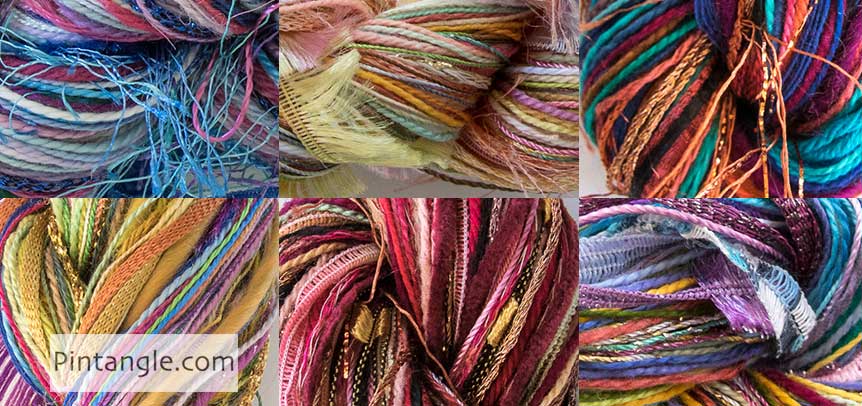
Experimenting with different threads can be expensive. You would normally have to buy a whole skein of each type of thread. My thread twisties are a combination of different threads to use in creative hand embroidery. These enable you to try out stitching with something other than stranded cotton. For the price of just a few skeins, you can experiment with a bundle of threads of luscious colours and many different textures.
These are creative embroiderers’ threads. With them, I hope to encourage you to experiment. Each Twistie is a thread bundle containing silk, cotton, rayon, and wool. Threads range from extra fine (the same thickness as 1 strand of embroidery floss) to chunky couchable textured yarns. All threads have a soft and manageable drape. Twisting them around a needle makes experimental hand embroidery an interesting journey rather than a battle. Many are hand-dyed by me. All are threads I use. You may find a similar thread twist, but no two are identical.
You will find my thread twisties in the Pintangle shop here.

hi, i like your website
thanks
Sharon, I have been away from reading blogs for a while and am glad I got here in time for this one. I think a button is a wonderful idea. All of my things are “slow” and those which aren’t are the ones which turn out badly.
I love this discussion and mention it in my blog here…
http://beadingatthebeach.blogspot.com/
Janet — you didn’t leave your blog address — would love to look at your tutorial! Maryjo
Some years ago, I developed a learn-to-quilt class outline called Slow Quilts, Slow Cooking and pitched it to our local university’s adult education – lifetime learning department as a route to women’s empowerment that uses a very traditional pathway. This department had previously taught a course in set design for amateur theatre lovers and so I thought this would be right up their alley – not! – I was promptly told to try the local technical school as they taught typing and sewing to adults. Instead I soldiered on making handcrafted one of a kind quilts for my clients and doing a lot of thinking. I have gradually honed the concepts begun back then and will soon be launching a new teaching website based on those principles.
Currently, I am conducting a tutorial on my blog that develops my idea that we all have creative abilities if we will only trust and develp them, but that discipline and work are required to do so.
Sharon,
Hi! I just found your blog and read this article. The idea of “Slow Cloth” for me is liberating. I weave tapestries and I sometimes feel like I’m not weaving fast enough. If I think of tapestry weaving in terms of “Slow Cloth”, I feel like I don’t have to worry about not weaving enough. Thank you for posting this article!
Heidi
I haven’t read all the comments or the other blog entries on this topic yet but I just have to pipe up and say that I, personally, would benefit from a “Slow Cloth” button for my blog. I’m one of those who feels guilty about not being able to get more done and who wants to improve my skill levels – which I acknowlege and accept takes time. The button would be a fun and gentle reminder of the real reason I do what I do.
I find I also have to agree with a previous commenter that the magazine you found on the newstand probably is not a publication for the demographic that reads your blog. I suspect those who come here are already practicing the art of creating Slow Cloth whether they do it with the aid of a machine or not. Nevertheless, I think it would be helpful to have a clearer delineation of crafts made with intention or purpose or meaning vs crafts stuck together in a hurry for gifting or selling in a bazaar setting. Here in the States the best we’ve come up with (that I’ve seen) is Fine Craft for those handmade items that are made with care and meaning.
Dear everyone,
I find it amazing how this ‘slow verses fast’ discussion gets everyone writing.
I do not care if people buy a quickly in the shop be it pretty or terrible. It is just their choice, like they buy plenty of other lovely items or trash.
I am very surprised that some people enjoy doing something in 15 minutes. Why don’t they buy it 100% ready made? That is even faster.
It reminds me of people buying ice cream and adding a cherry on top of each serving and present it to your guests as ‘home made’. Maybe there is something ‘exciting or prestigious’ about home made. I wonder what that is.
In my opinion there are only three good reasons for doing things yourself:
1. because you enjoy to do it yourself (and then time is no miss-use)
2. because it saves money (then it should go fast otherwise you may consider finding a job that pays better)
3. because it will be unique
Best regards,
Tilleke
That’s an interesting post by nelpax, and it made me think. The kits, scraps, cutouts and stickers had to be designed and made first, before they went into production. So some ‘real’ craft went into these before they went onto the mass market for ‘quick projects’. I had the thought, I’m not sure what it means. And I STILL don’t know what to call myself!
Sharon,
Thank you for starting this discussion! I find this whole conversation fascinating. I’m currently working on learning silk embroidery – a process which began in 2001 with raising silkworms, learning about cocoons, learning to reel silk, learning to throw, degum, and dye it, figuring out what kind of floss I want for the effect I’m aiming for – I’m definitely slow.
http://oakenking.livejournal.com/167681.html“ rel=”nofollow”> More on my blog.
Sharon, as you know, I work throughout many different craft mediums. The term “Slow Craft” could apply to any of these.
I posted about it at my blog at:
http://madebymisa.blogspot.com/2007/12/slow-craft.html
The middle of my post turns into somewhat of a rant, but the idea behind it is there.
I don’t feel we need another category to label or define those of us who work with cloth. I think at some point everyone tends to make a quick project,even if out of pure boredom or to work with something different while undertaking a slow cloth project. I for one keep a slow cloth project in th form of a large crazy quilt, working at all times however I rarely share it as it is in progress because it is personal to me and I enjoy my private journey with it and then the reveal.
I do take on small fast cloth projects simply because they look interesting and appealing to me and yes, they can be done quickly. This does not take away from it’s quality or the thought process behind it.I am one who works quite fast no matter what the project because I choose what interests me and I delve into it with full force and need to work on it as a comforting thing.
Perhaps the question is, do you take consideration in your work or do you just want quantity? I don’t feel time is a factor. You can create a beautiful item or an awful one in a week or a year,it just depends on your standards, not time. JMHO
I have been following the interesting discussion on the ‘fast crafts’ and the slow cloth and it is interesting. I have been fortunate to have grown up in a home where the threaded needle was treasured and used. I can’t ever remember not being surrounded with fabrics, threads etc. However, even though I cherish needlework to do and give, I feel that there are times that one could give a gift of (slow cloth) needlework that is not appreciated. One just has to look at flea market and yard sales to see this ‘unappreciated’ work. Maybe there is a place for craft gifting and not using ‘slow’ cloth. My thoughts.. for what they are worth.
Querida Sharon…
Ante todo sobre lo que dices se debe separar dos procesos uno si se esta creando o solo copiando.
El bordar, tejer, coser o hacer una manualidad implica la aplicación de un método, es decir solo ejecución de una tarea, este método será tan rápido como la Habilidad y experiencia de quien lo aplica, esto es diferente de acuerdo a cada persona, No implica selección de variables si no ejecución de actividad. No implica análisis, pues esto ya se ejecuto por quien realizo el diseño.
Crear o diseñar no es lo mismo. El crear implica un estudio previo de muchas variables según sea el caso. Entre ellas observar, conocer, analizar y confeccionar, por ello crear o diseñar implica el estudio de tantas variables como así se estipulen en el concepto a generar. El crear nunca será lo mismo que solo la aplicación de un método.
Otra cosa muy distinta cuando esta creando y confeccionando. Pues estoy aplicando ambas actividades, por esto es que a veces hay labores que son distintas a la hora del trabajo y el boceto. Pues al momento de la ejecución se hacen cambios.
Pero el diseñar también depende de la práctica y experiencia… La imaginación se hace más rápida según la experiencia… El diseño es un proceso mucho mas largo a la final que el de aplicación de una técnica. No todos pueden aprender a diseñar, esta científicamente comprobado que los diseñadores nacen con esta cualidad, esto no se puede generar ni con estudios. Solo se pude dar un método para crear más no la cualidad del creador.
Así que en mi opinión la rapidez de una obra depende de la experiencia, imaginación, y aptitudes de quien ejecute la labor, cada uno posee un tiempo para todo. Para unos la creatividad suele ser mas rápida, y la ejecución mas lenta. Para otros es al revés. A quienes no saben nada del método pero son excelentes creadores. Y quienes son muy técnicos y solo saben copiar un diseño con mucha calidad. Es cuestión de cómo funciona nuestro cerebro y que tanto lo hemos practicado.
En mis clases de la universidad puedo observar como con una misma determinante en distintos estudiantes dan formas tan diversas y variadas a edificios arquitectónicos… y los tiempos de las etapas son distintos para cada cual… Es algo que viene con nuestro ser desde que nacemos, lo mas largo o con tiempo no siempre significa que es lo mejor. O lo mas rápido… Todo tiene un tiempo de acuerdo a cada cual. Solo es que cada cual acepte como es, por ello yo les digo a mis alumnos el hacer un edificio depende de las aptitudes de cada cual…Cada ser es totalmente distinto uno de otro… Hay cosas que se aprenden, que se pueden mejorar, pero hay quienes nacen con dones y eso no se puede aprender, No todos pueden ser Mozart, ni Gaudi, lo importante es ser uno mismo.
Dear Sharon…
Above all about what you say two processes should be separated if one is creating or just copying.
The embroidery, knitting, sewing or making a craft involves applying a method that is just execution of a task, this method will be as fast as the skill and experience of those who applied, this is different according to each person, not involves selection of variables without enforcement activity. It involves analysis, as this has already been run by whoever performs the design.
Create or design is not the same. Creating implies a prior study of many variables as the case may be. Among them see, hear, analyze and prepare thus create or design involves consideration of many variables as is stipulated in the concept to generate. The creation will never be the same as the implementation of a single method.
Another very different when it created and prepared. Well, I am applying both activities, for this is that sometimes there are tasks that are different in terms of work and sketch. So when implementing changes are made.
But the design also depends on practice and experience… Imagination becomes more rapid as the experience… The design is a much longer in the finals of the application of a technique. Not everyone can learn to design, the scientifically proven that designers are born with this quality, this can not be generated or studies. Only you can provide a method to create more rather than quality of the creator.
So in my opinion the speed of a work depends on experience, imagination and skills of those who perform the work, each has a time for everything. For some creativity is often faster and slower performance. For others it is the other way around. To those who know nothing of the method but are excellent artists. And those who are very technical and knows just copy a design with a lot of quality. It’s a matter of how our brains and that what we practiced.
En mis clases de la universidad puedo observar como con una misma determinante en distintos estudiantes dan formas tan diversas y variadas a edificios arquitectónicos… y los tiempos de las etapas son distintos para cada cual… It’s something that comes with our being from the day we are born, or with longer time does not always mean that’s the best thing. Or faster… Everything has a time according to each one. Solo is that everyone accepts as is why I tell my students to make a building depends on the skills of each… Every being is completely different from one another… There are things that are learned, which can be improved, but some people are born with gifts, and that can not be learned, not everyone can be Mozart, or Gaudi, the important thing is to be oneself.