
As the name suggests, Basque stitch is found on old embroideries from the Basque region across the boundary between northern Spain and southwestern France. You can also find it in embroidery from Portugal. Basque stitch is also known as twisted daisy border stitch. It is a variety of twisted chain stitch, worked in lines or circles, a bit like a buttonhole stitch.
Basque stitch creates a line of twisted loops, which looks good on a curved line.
Once you get the hang of the rhythm of this stitch, it is very relaxing and enjoyable to work.
How to work Basque stitch
Work this stitch over two imaginary lines. Bring the thread out on the upper line, and take a large bite of the fabric, so that you insert the needle on the top line to emerge from the back on the lower line. Take the thread across the needle, then loop the thread under the needle’s point.
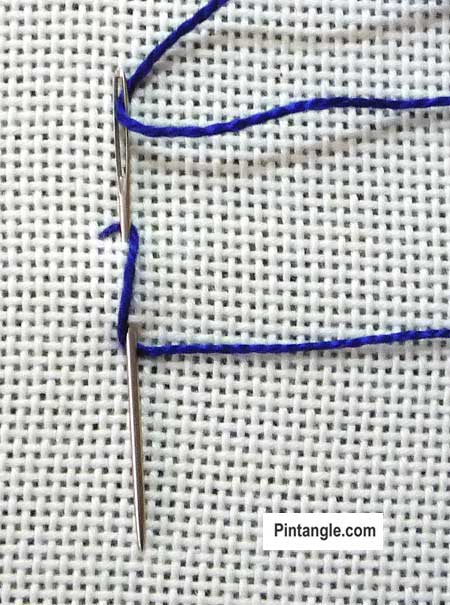
Pull the needle through the fabric to form a twisted loop. Insert the needle on the lower line and bring it out just beside the top of the loop.
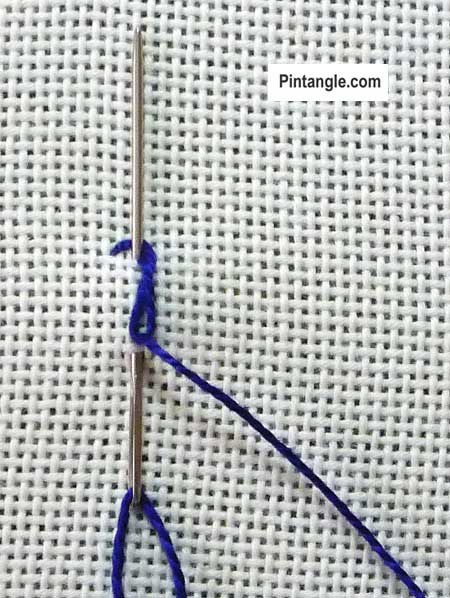
Take the needle through the fabric and repeat this process along the line.
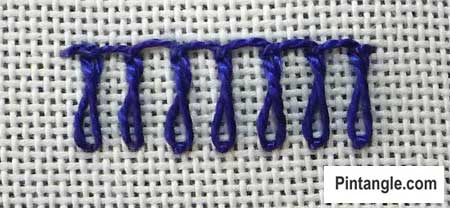
Worked in a circular manner, this stitch forms floral shapes, which means it can be used to pattern areas.

Another tip is to attach a bead or button placed in the centre of the circle. This is particularly effective in crazy quilting. You can attach small seed beads at the end of the loop or inside the loop.
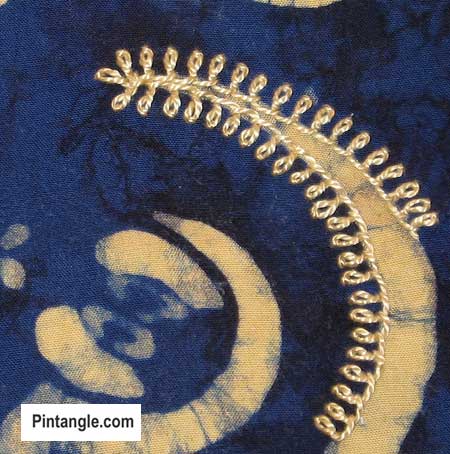
This is a stitch that is absolutely marvellous on a curve. I worked this sample on a piece of cotton batik and just picked out the curve of the printed pattern.
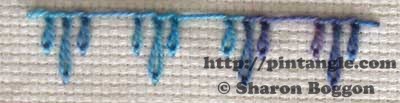
Here, I have worked Basque stitch in a line. You can create patterns by extending the loops at regular intervals.
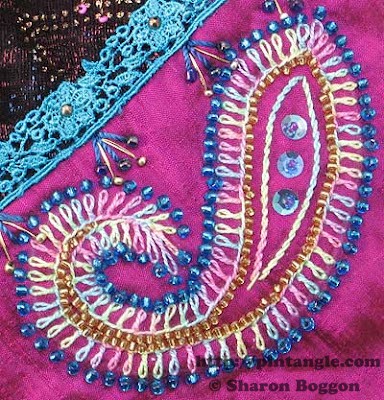
This last example is where I used it in crazy quilting. It is really good at emphasising a line in a motif, such as a paisley.
Have you seen my Stitchers Templates?
Create your own designs with Sharon’s easy-to-use stitchers templates. Combine shapes to create hundreds of patterns and designs to embroider. It is the ultimate mix-and-match fun for stitchers of all skill levels. I created them to be as versatile as possible. I include four multi-patterned templates in each set. You will find them easy to use, totally clear to help you position them on your work, and they are nice and compact to fit in your sewing box. Each set comes with an e-book filled with patterns and designs that you can create and use as a jumping-off spot for your own designs. They are available now in our shop here!
Happy stitching!

A new stitch for me to learn. Thanks for introducing.
My trials are here.
http://hobbysewing.blogspot.com/2020/09/tast-20-beyond-tast-20.html
Finally finished with my July stitches. See it at
http://sparemomentstitching.wordpress.com/2012/10/03/july-tast-and-cqjp-in-september/
je rattrape mon retard …..
I loved this stitch!
http://eclecticlamb.com/2012/07/31/week-29-basque-stitch/
Basque stitch was so much fun to stitch and is now a favourite. You can see my sample on my blog here: http://dinkydideequilts.blogspot.com.au/2012/07/ethnic-or-olympic.html
I enjoyed doing this stitch, and ended up making flowers and a sun. Added these to my TAST embroidery journal. Here are some pictures:
http://harvestmoonbyhand.blogspot.com/2012/07/take-stitch-tuesday-basque-stitch-week.html
Here is my Sampler. Only a few stitches for now
http://summersofindia.blogspot.in/2012/07/basque-stitch-2.html
But I am going to work on it later for more variations and combinations.
Ms Sharma
Here’s my week 29 TAST challenge. Basque stitch is another that can be very “fluid”.
http://stitchinfingers.ning.com/photo/octopus-tast?context=user
Hi Sharon,
Here we are Sunday night again.
I blogged about the process at http://www.carorose.typepad.com,
and put up an image in the Flickr group here http://www.flickr.com/groups/56846286@N00/
Cheers
Carolyn
This is another peacock from me – http://letslearnembroidery.blogspot.com/2012/07/basque-stitch-peacock.html