
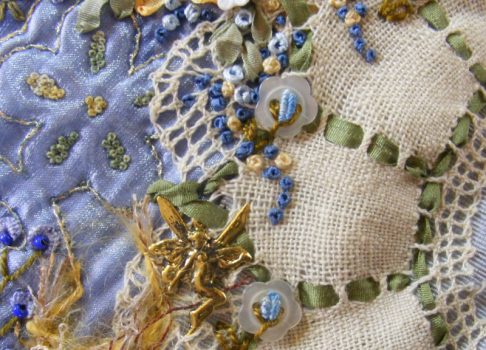
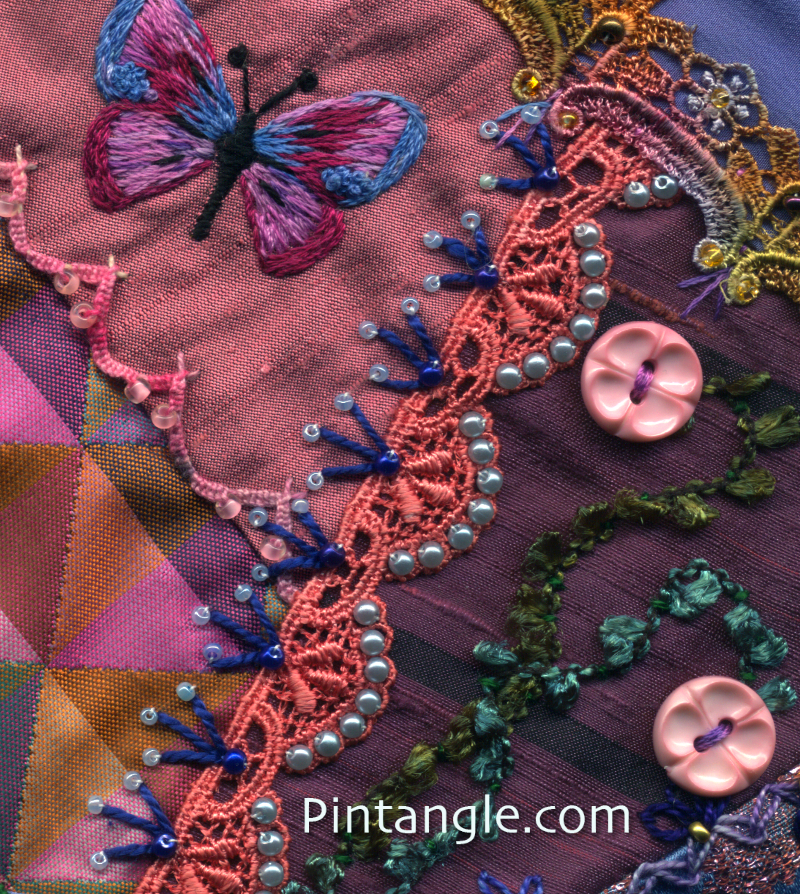
Here are a few fun ideas and techniques to embellish crazy quilt blocks with more than embroidery alone. Beginners often think that you embellish crazy quilt seams you use embroidery and perhaps add a few beads but you can do a whole lot more on a crazy quilt block to add interest life and sheer exuberance.
Here is a few ideas and techniques to embellish crazy quilt block using methods other than stitching. Before I start I stress that there are no hard and fast rules in crazy quilting, and today more or less anything goes!
Lace, Ribbons and Braids:
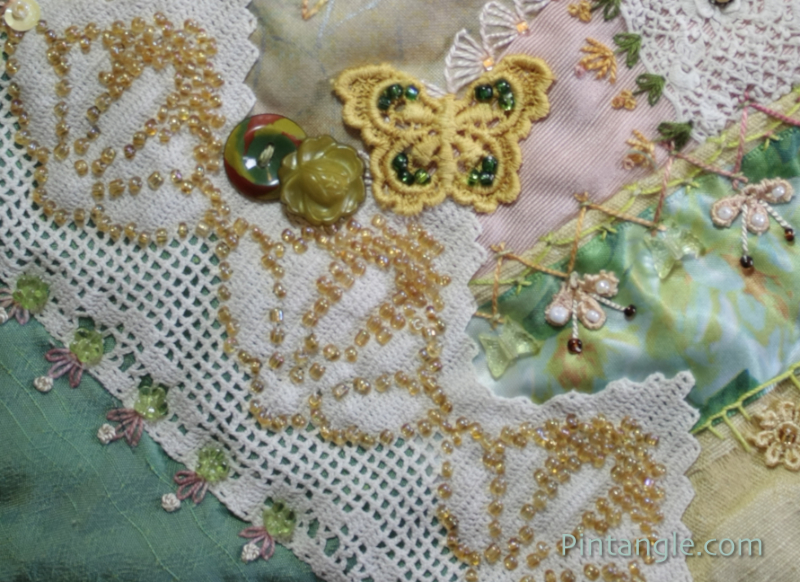
I add interest to a crazy quilt block with the liberal use of lace, braids, ribbons, buttons, beads and charms. My main tip is to think about embellishing from the start when you assemble the block. When you are piecing think of the block as a whole and add lace, ribbons as you piece. As you piece your block, tuck the ends of lace, ribbons and braids into the seams as you go. I use the flip and sew method. When I add embroidery to the seams on the block I often embroider the lace, ribbons and braids too!
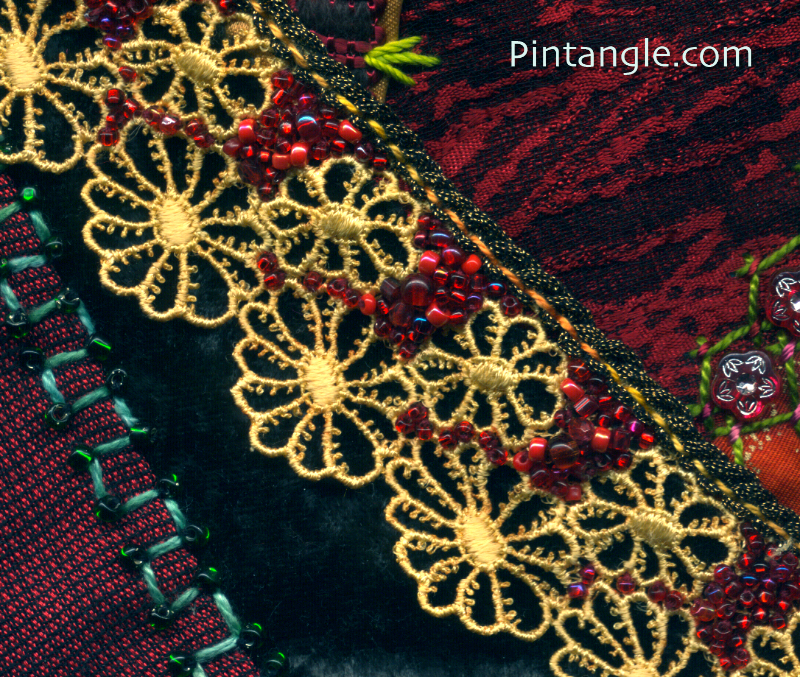
Regular readers will know I regularly embellish lace with both beads and embroidery. In the photograph above I beaded the lace with red beads and the edge is embroidered with Pekinese stitch
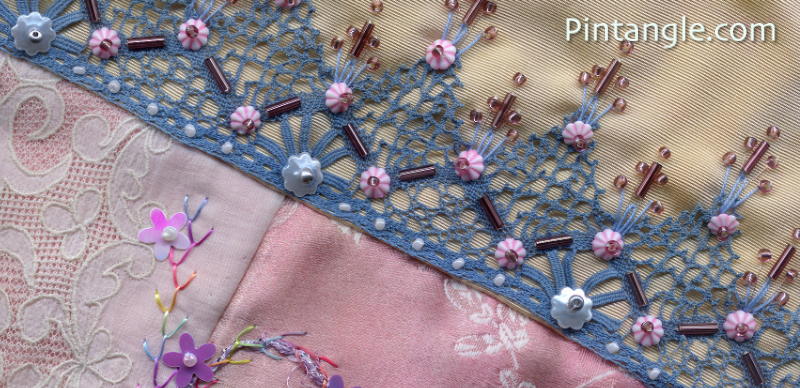
Lace sets up a contrast of texture yet is light and interesting to stitch. Embellishment on top of lace such as stitching or beading areas deepens the areas of interest. It creates a deep texture that will act to slow the eye down as your viewer lingers over the area.
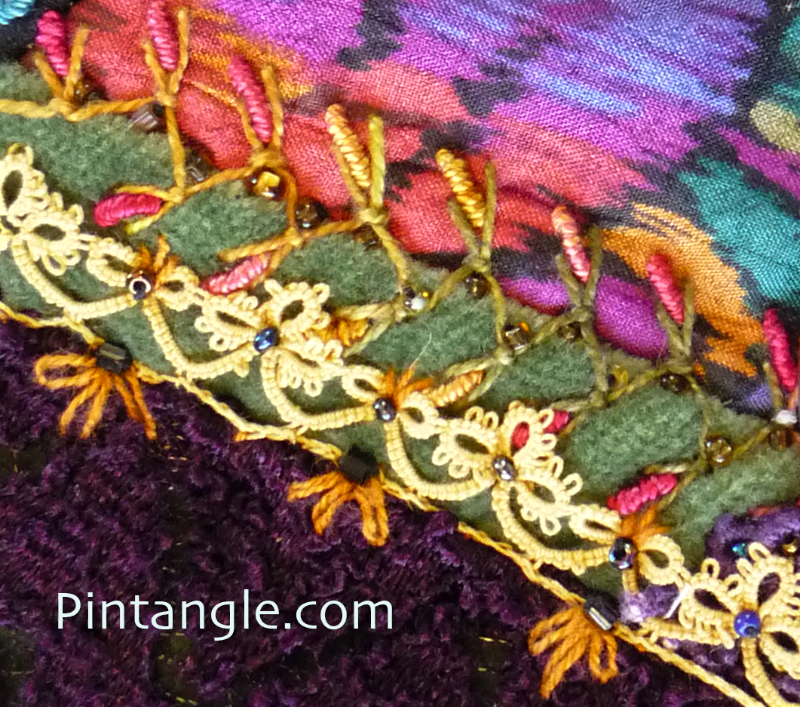
Often there can be as much embroidery as lace. Here in the photo below is an example of tatting and embroidery along a seam.
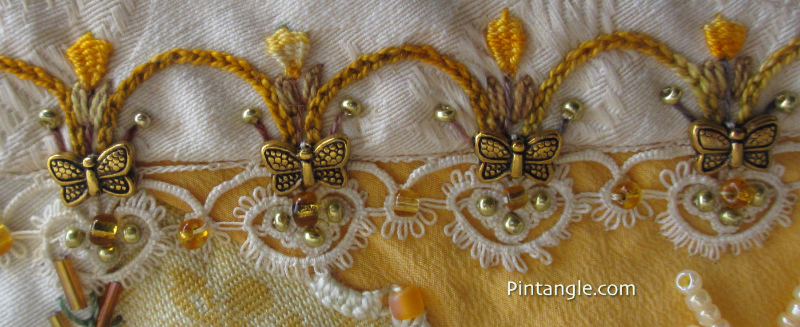
In the photo below I have used tied Herringbone over a satin ribbon.
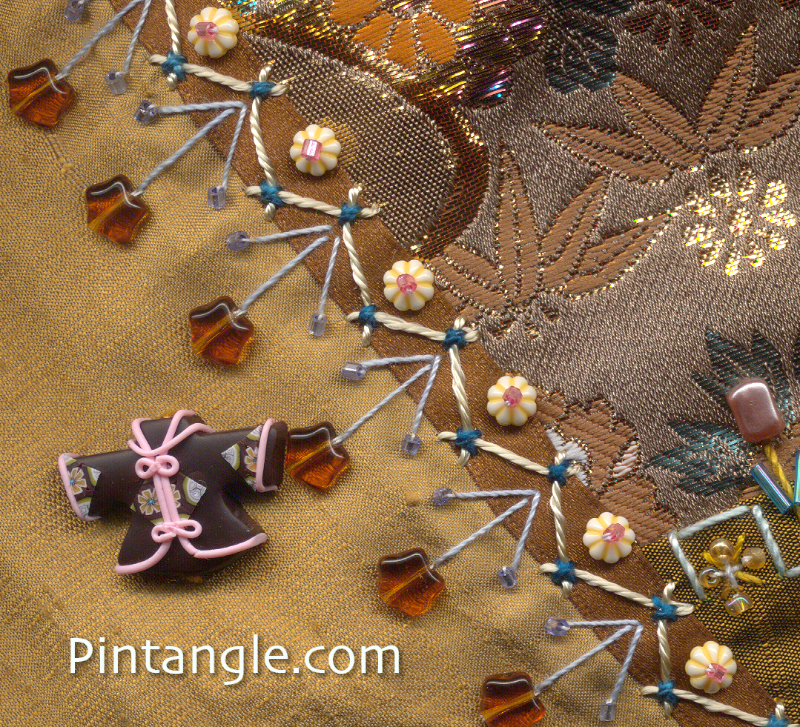
Braids, ribbons and bands of lace create very strong directional lines on a block. You can use these linear elements to your advantage and guide the viewers eye around the block. The idea to guide the viewer around the block. Not have them speed along a line so fast that they don’t stop to look. This is why I place embroidery along the side of ribbons and lace. The added texture increases interest and it will slow the viewers eye down as they look at the detail. In the photo below beads, straight stitches and detached chain stitches.
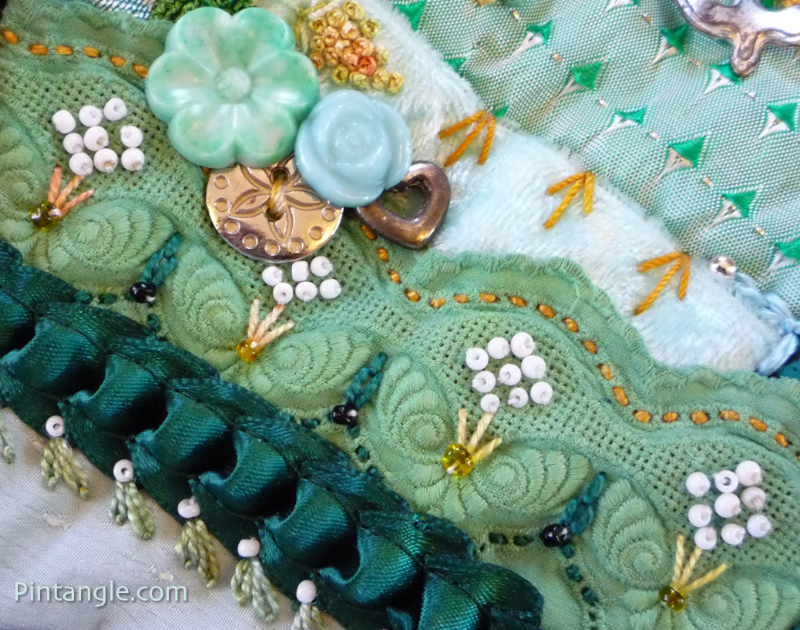
The same applies to adding beadwork to lace. The complex texture acts to slow the eye down as people enjoy it. It’s like walking along a path. You don’t want people running like a bunch of kids chasing a ball, but walking at an easy mature pace, in order to take notice of what is going on. If the line is long and simple the eye will simply zip by, running down the path too fast. You need to slow the viewers eye down – you want them to stop and look. You need to give them something to stumble over. Interesting embroidery along the side of a braid or lace will do this for you. If you include beads, your viewers eye will slow to take them in.
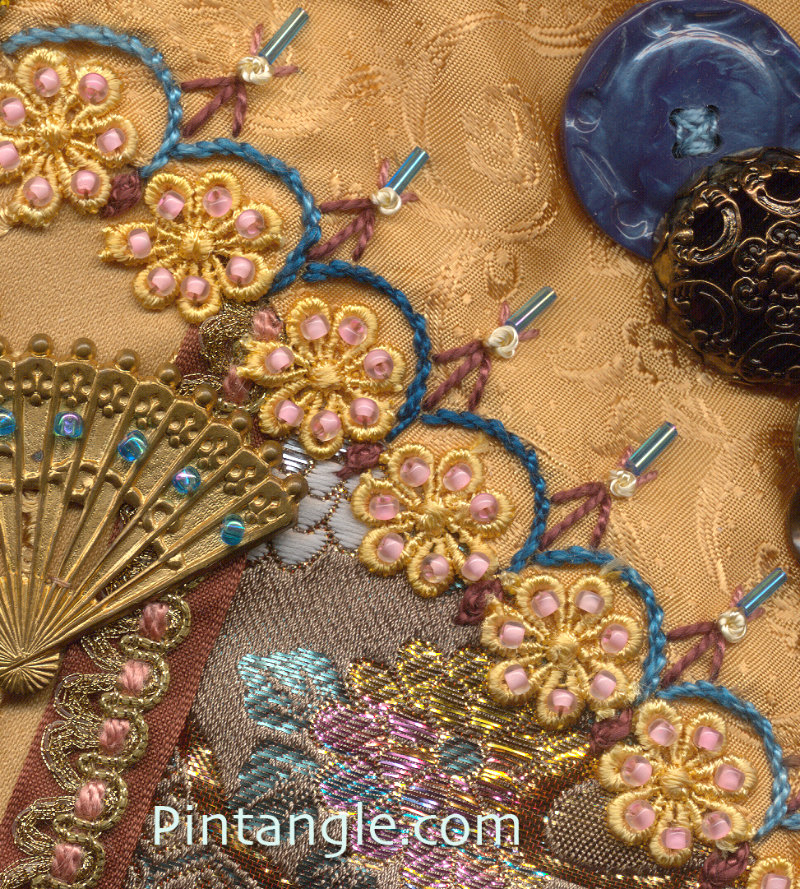
The other tick you can use is give people something interesting to look at just off the path, so they deviate for a moment and then return. A slight visual side track can be a charm, button, or a lace motif close to the path.
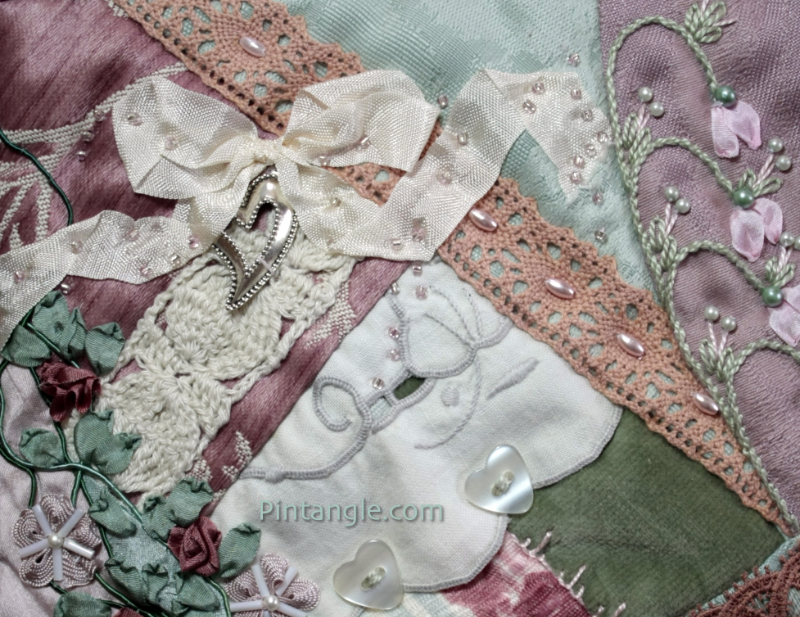
There are also what I call ‘meandering’ embellishments and curved lines. Ribbons can also be used to soften a line. Firstly a ribbon can meander about a block and a flowing curved line will slow the eye down. Ribbons can be tied into a bow and added to a crazy quilt block with the tail of the bow flowing elsewhere over the block.
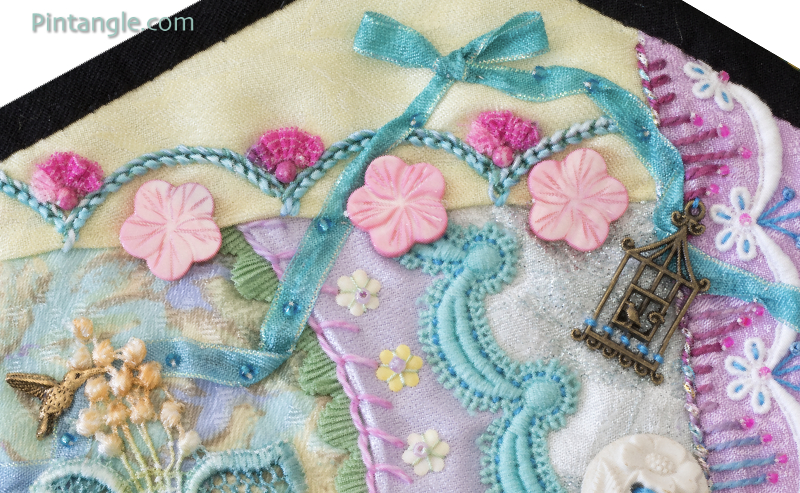
When working with ribbon don’t forget ruching is a simple, easy technique that is easily embellished further with stitching and beading.
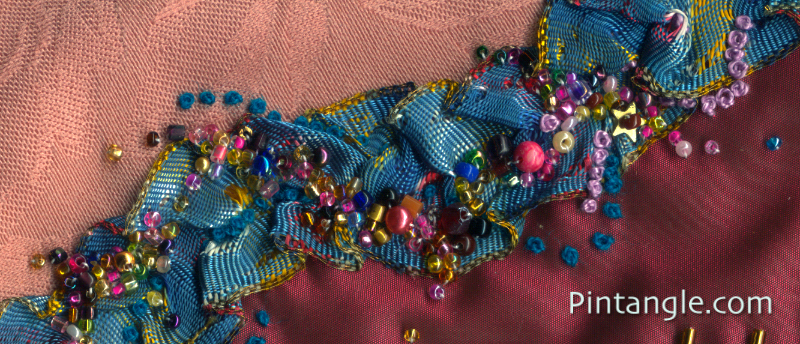
You can also easily couch down ribbon and rick rack using detached chain stitches (as in the photo below) Buttonhole stitch, Zigzag chain stitch (great for using on rick rack) Herringbone stitch, or Cretan stitch. This technique will add texture to your embellished seams.
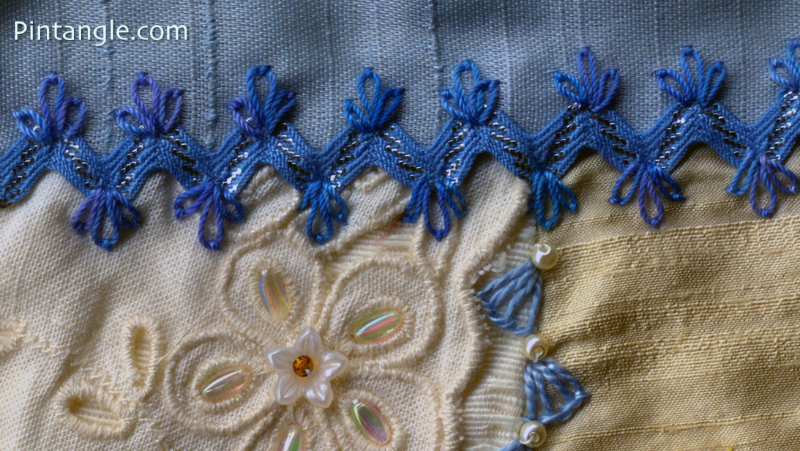
Another example of using ric rac braid to embellish a crazy quilt block using Zigzag chain stitch to secure it to the block.
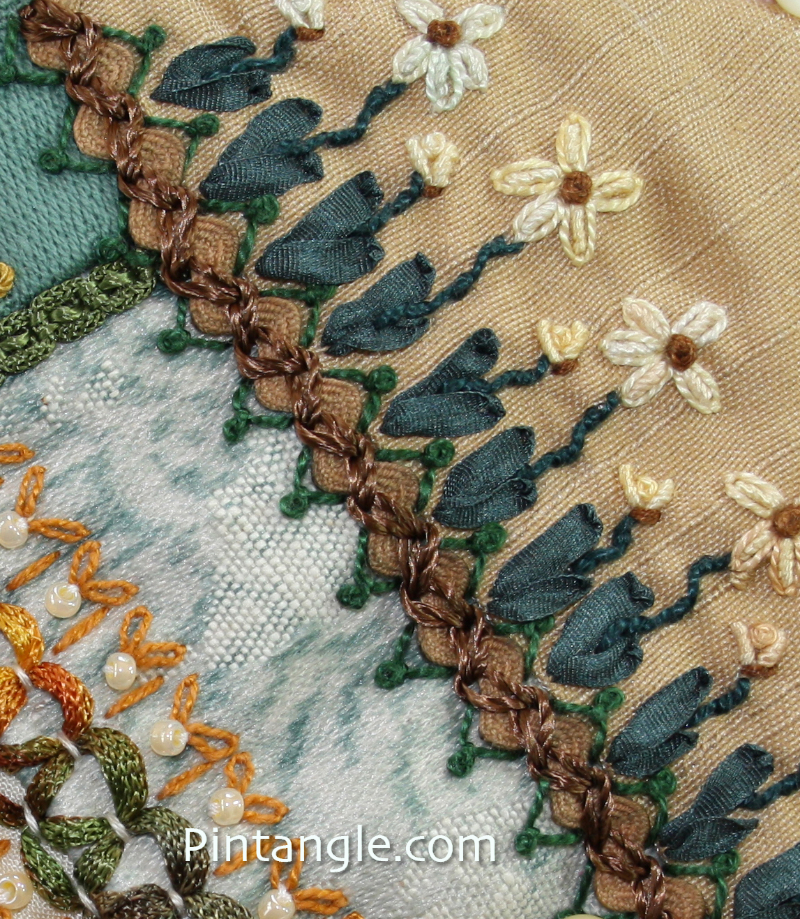
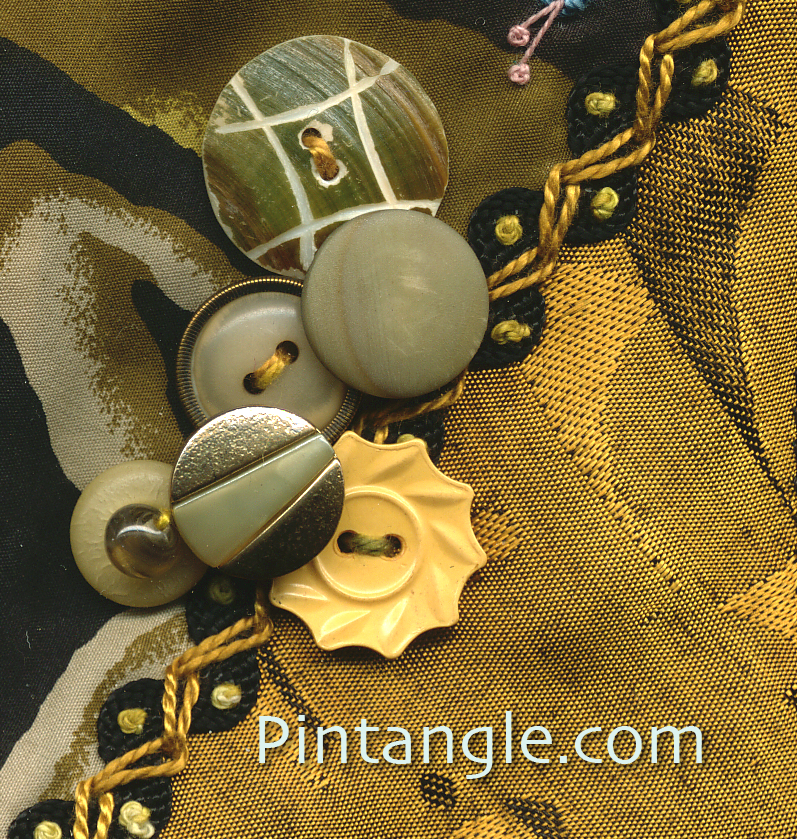
Buttons and ric rac embellish this block.
Hankies and doilies:
Other items you can tuck into the seams as you assemble your block are doilies and hankies. These are stitched in as I piece the block.
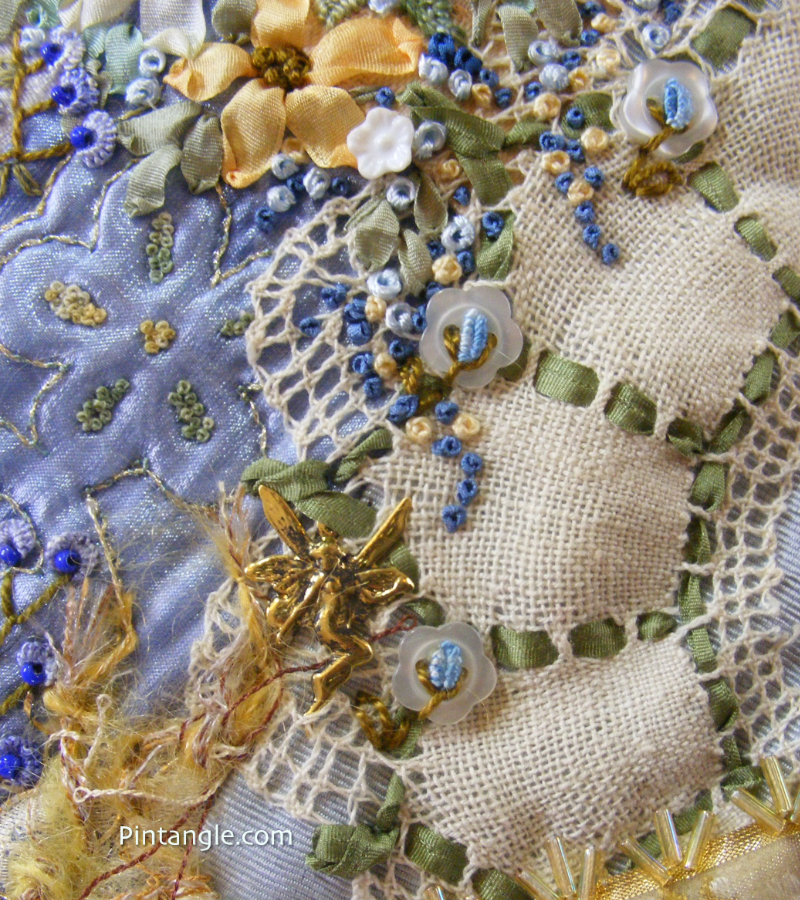
Doilies can act to accentuate a curve. You can easily add further embellishments of buttons, ribbon work and beading to them.
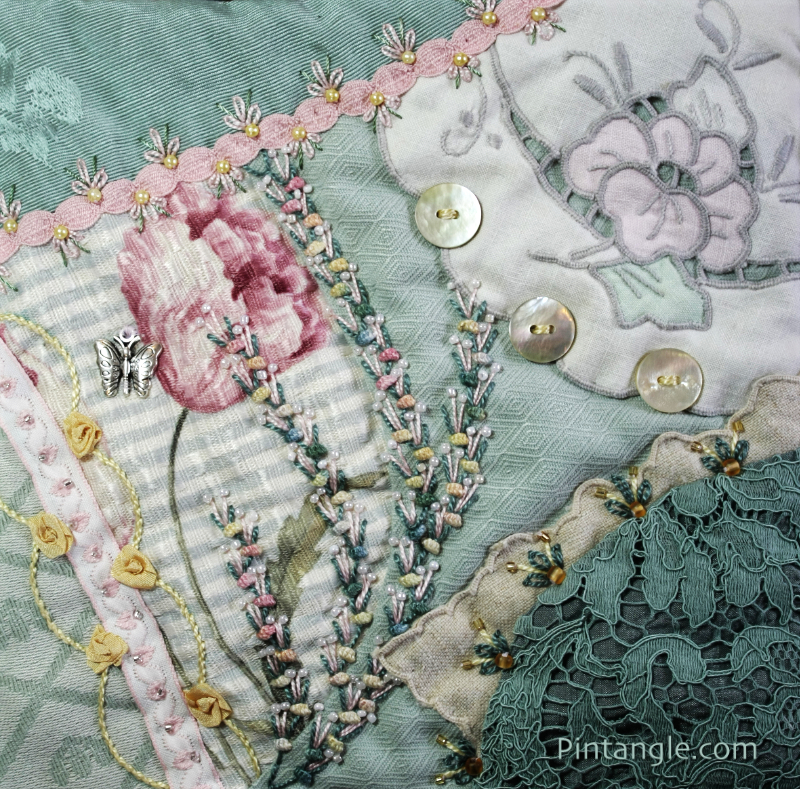
Sections of doilies can be incorporated in a crazy quilt block at the piecing stage. Often you can use a half or a quarter to break a long seam line. Simply place it to overlap the problem line and emphasise it with embroidery, beading or button clusters and the curved line will swing the eye off in another direction.
Both hankies and doilies can be used to break a long seam. Long seams in a crazy quilt block can be a problem because the eye will just scoot along them. A well placed hankie, doily or lace motif can stop the eye and make the eye veer off to another area of the block.
Prairie Points
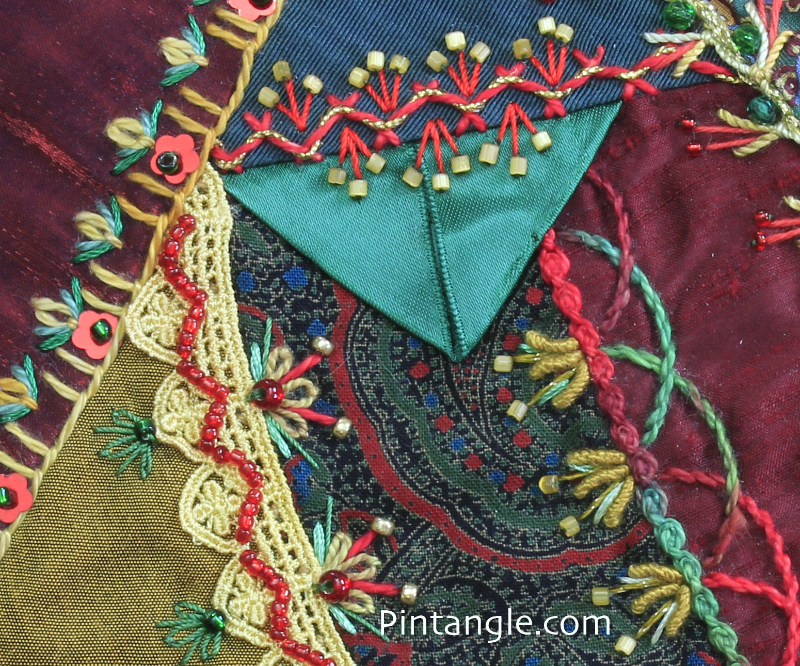
Another embellishment I add at the piecing stage is to include some Prairie Points. They are quick and easy to make as you can fold fabric or ribbon into a triangle shape and add them.
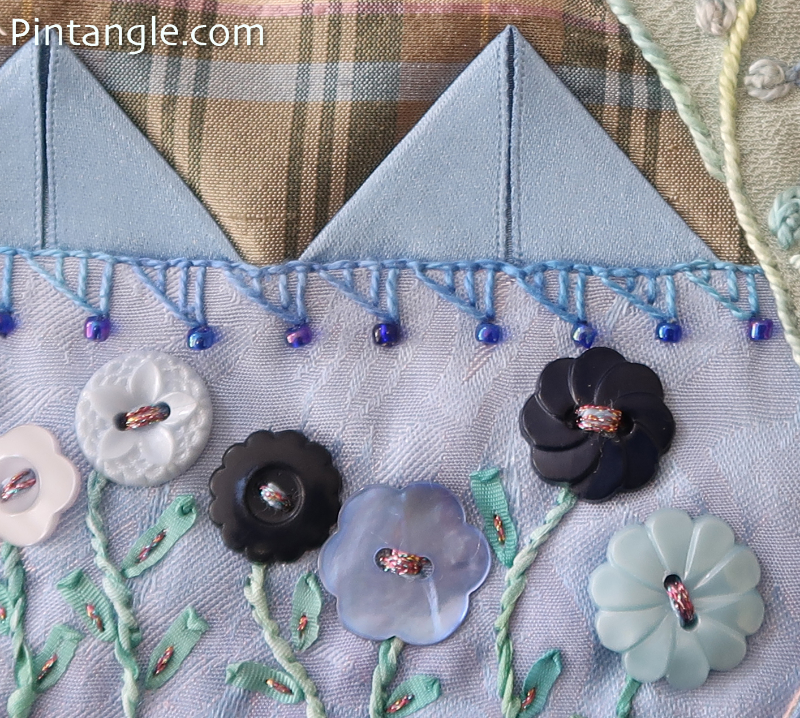
Lace Motifs and single Dodads:
Single lace motifs, buttons, charms and beads can all form the main point of emphasis on a block that can also act to attract the eye and draw the viewer around the block. I often add beading to them to add a little extra emphasis if it’s required.

A lace motif can become a main point of interest on a block. As a side note if you want the free pattern and details on how I worked this block you will find it here.
Buttons, Beads and charms:
After embroidering all the seams, motifs, lace and braids on a crazy block I add what I call the ‘hard’ embellishments. I don’t mean they are hard to do, just that as elements they are physically hard, such as things like charms, buttons and beads. If you add them too soon to a block you will find that as you do your embroidery your thread will constantly catch on them and tangle. So for me this type of “hard” embellishment is last phase of a block.
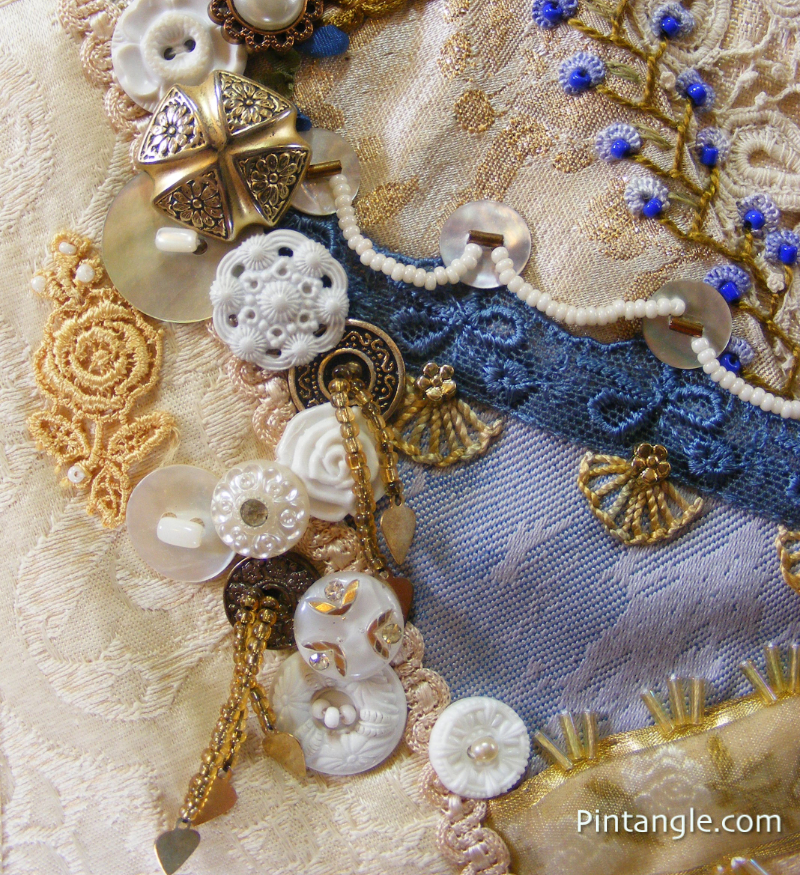
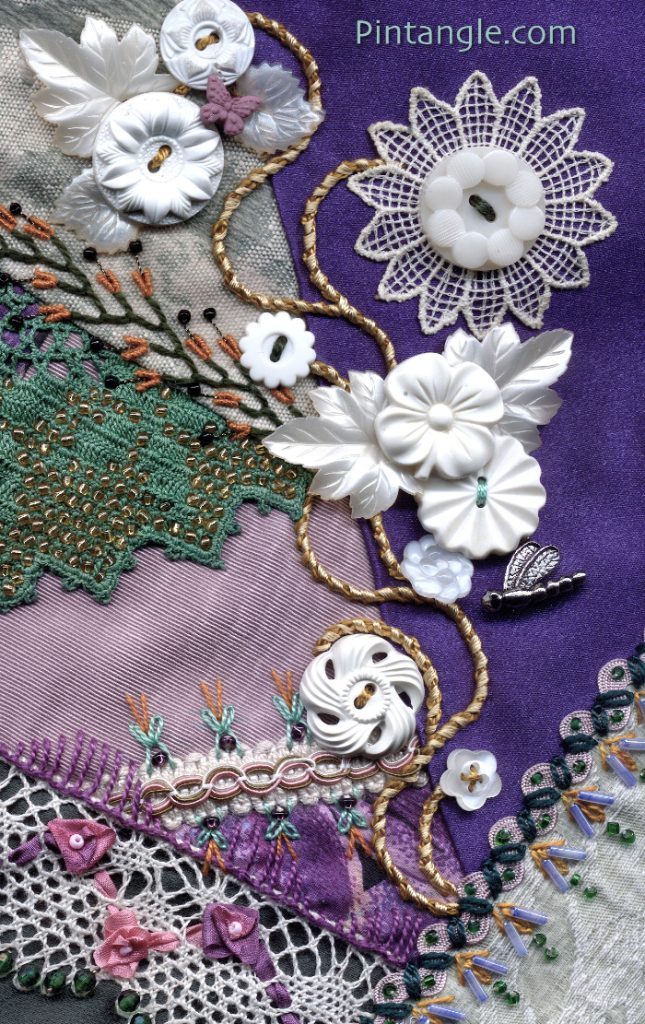
The size and colour of beads, charms, buttons, and lace motifs not only add interest but because of their nature they will influence the composition of a block. These elements will attract the eye from a distance and also act to draw the eye from one point in the block to another.
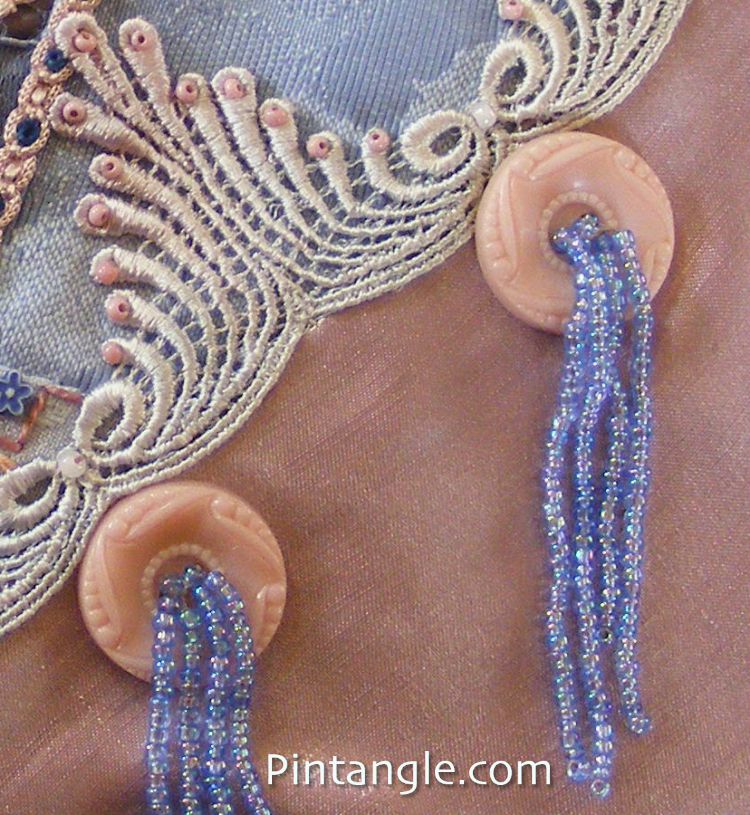
The size of buttons and beads is important. One very large button in a corner will draw the eye to it. A cluster of large buttons will do this even more. Vary the size of buttons and charms to change the dominance in a particular area or balance it with another area on the block. I usually add buttons and embellishments in odd numbers. For instance I will select 3 or 5 buttons, not 4.
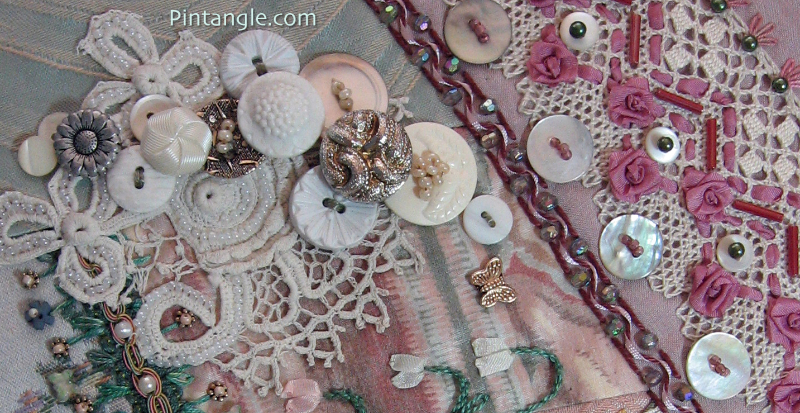
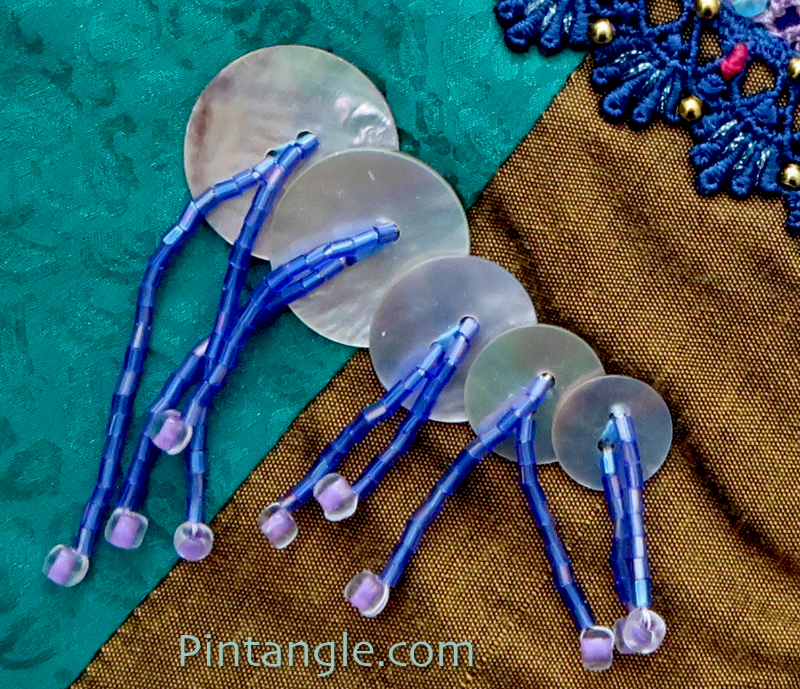
You can easily combine buttons and beads into clusters of rich embellished texture. Since these buttons do not have to function as buttons you can add beaded tassels and drops to the centres or pile seed beads in the middle.
These are a few ideas on how you might go about further embellishing crazy quilt blocks with more than embroidery. I hope you have enjoyed this article and as usual feel free to leave comments, or questions.
Have you seen my Stitchers Templates?
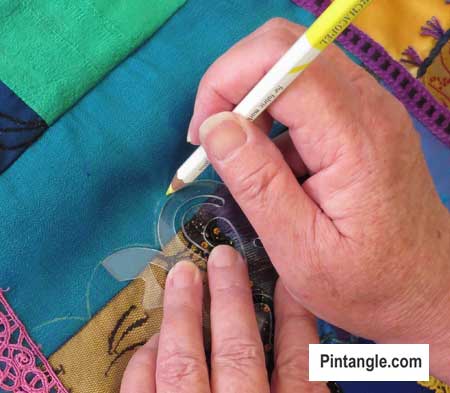
Create your own designs with Sharon’s easy-to-use stitchers templates. Combine shapes to create hundreds of patterns and designs to embroider. It is the ultimate mix-and-match fun for stitchers of all skill levels. I created them to be as versatile as possible. I include four multi-patterned templates in each set. You will find them easy to use, totally clear to help you position them on your work, and they are nice and compact to fit in your sewing box. Each set comes with an e-book filled with patterns and designs that you can create and use as a jumping-off spot for your own designs. They are available now in our shop here!
Happy stitching!
Follow Pintangle and have it delivered to your inbox
You can have Pintangle delivered to your inbox — In the side bar use the Subscribe to Pintangle box or If you are on a mobile scroll to the bottom the of the page to find the Subscribe to Pintangle option. In either case type in your email address and click on the Subscribe button below. Then check your email inbox for a confirmation email and click the link to confirm your subscription. If you don’t see a confirmation email, check your spam folder — sometimes the computer puts it there.
