
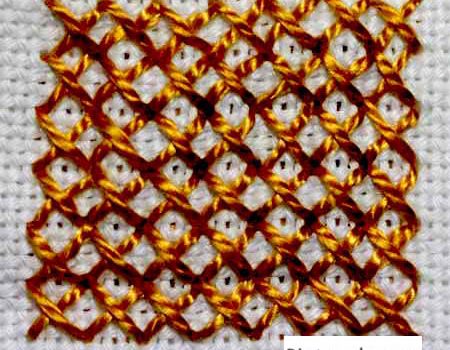
Back stitch trellis is a filling stitch that is ideal for covering large areas. The open geometric filling is made up of intersecting diagonal lines of back stitch. This geometric design can act as the foundation of other embellishments and stitches. You can leave it as is for a contemporary feel to your work. Or you can work the lines of back stitch further apart and larger, in order to leave space for adding beads and other stitches.
This stitch is a very quick and easy stitch to work and is best worked on an even-weave fabric such as linen or Aida. If you want to use non-even-weave fabric, mark the rows with a soluble pen. If you work an irregular shape, use partial back stitches to fill the shape to the edge.
How to Stitch Back Stitch Trellis
You need to know how to do Back stitch. If you need a refresher on this, you will find a tutorial for Back stitch here. Back stitch trellis is worked in 2 layers.
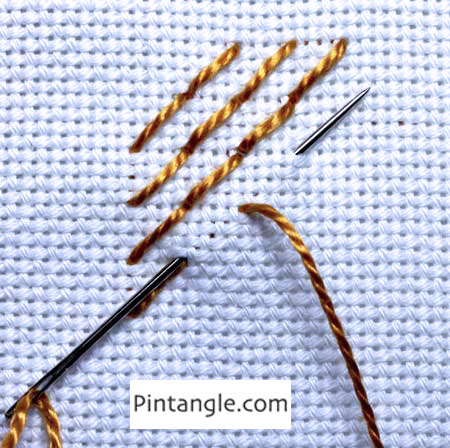
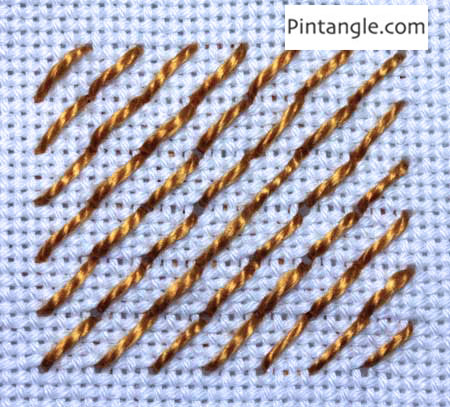
Keeping your stitches an even length, work a series of diagonal parallel rows of backstitch. The larger you work your back stitches, the larger the squares of the grid will be.
Work the next layer of stitches in the opposite direction, placing each stitch at right angles to the previous row.
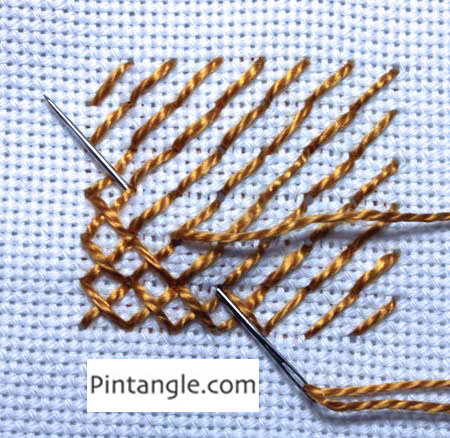
For neatness, make sure to work stitches into the holes made by the previous row
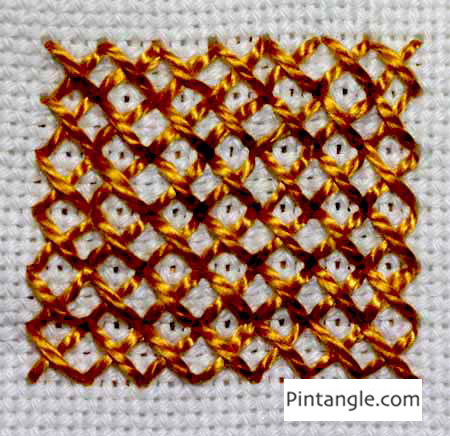
I hope you enjoy Back Stitch Trellis!
Thread Twisties!
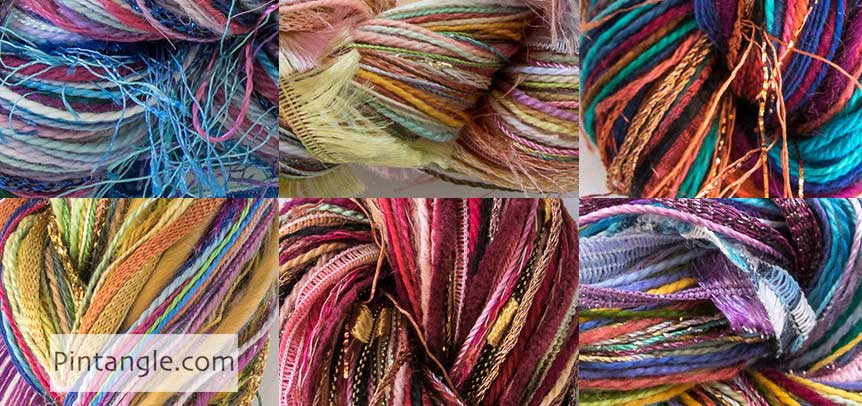
Experimenting with different threads can be expensive. You would normally have to buy a whole skein of each type of thread. My thread twisties are a combination of different threads to use in creative hand embroidery. These enable you to try out stitching with something other than stranded cotton. For the price of just a few skeins, you can experiment with a bundle of threads of luscious colours and many different textures.
These are creative embroiderers’ threads. With them, I hope to encourage you to experiment. Each Twistie is a thread bundle containing silk, cotton, rayon, and wool. Threads range from extra fine (the same thickness as 1 strand of embroidery floss) to chunky couchable textured yarns. All threads have a soft and manageable drape. Twisting them around a needle makes experimental hand embroidery an interesting journey rather than a battle. Many are hand-dyed by me. All are threads I use. You may find a similar thread twist, but no two are identical.
You will find my thread twisties in the Pintangle shop here.

I’ve never thought of a Backstitched filling stitch. It is so beautifully done on the bias. Wouldn’t it be good as a real trellis with stitched flowers?
Hi Queenie yes I have seen it used that way ie as a trellis with flowers – the lady used bullion roses. I think many stitches worked on the diagonal would have a fresh look.