
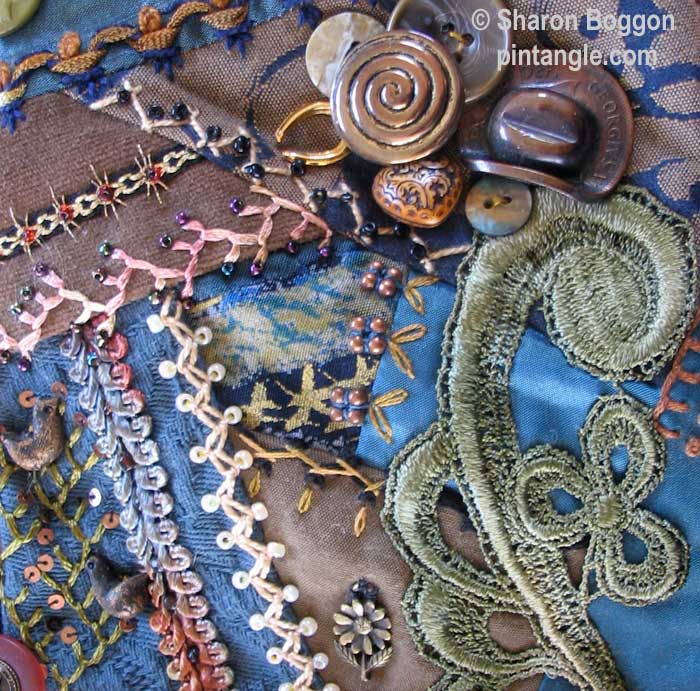
Crazy Quilt block 69 is a a muted bronze/green colour scheme which was an interesting block to work. In the top right hand corner has an unusual vintage souvenir. During World War II Australian soldiers made miniature slouch hats from Australian half pennies and pennies. They were pressed over a shape. I remember them from when I was a child. Dad said it was something people did during the war. Slouch hat pennies are an example of trench art and the older ones are now collectors pieces.
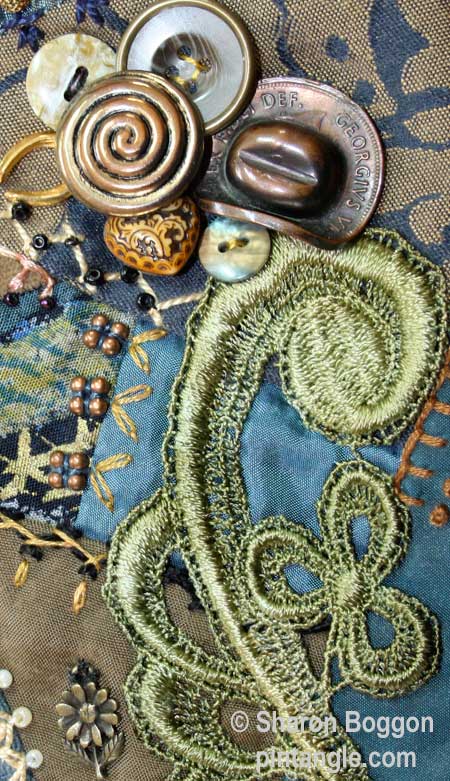
The slouch hat penny sits in a button cluster above a piece of hand dyed lace.
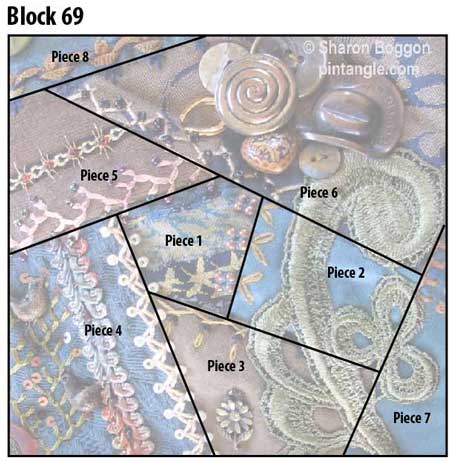
Fabrics used on Crazy Quilt Block 69
Regular readers will know that this is a millennium quilt with the challenge to use 2001 unique pieces of fabric, lace, braids, charms, buttons or ribbons. The on going item and fabric count listed below is the number of items used up to that block in the quilt. You can read about the backstory and see the finished quilt here.
- Piece 1: Cotton
- Piece 2: Silk
- Piece 3: Cotton
- Piece 4: Cotton Synthetic mix
- Piece 5: Velvet
- Piece 6: Cotton Synthetic Brocade
- Piece 7: Cotton
- Piece 8: Silk
Items used on Crazy Quilt Block 69
The on going item count listed below are the items used to date in this series of articles.
- Fabric: 8
- Lace, braid and ribbon: 3
- Buttons and charms: 8
- Total items on this block: 19
- Total tally of items on the quilt so far: 1327

How I Embroidered and embellished Block 69
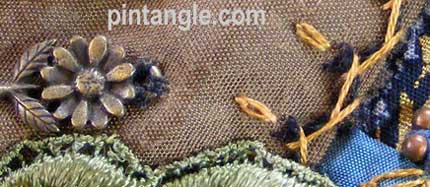
Along the side of patch 3 a line of Double Herringbone is worked in a thicker black wool thread. The second line of herringbone is worked in 2 strands of tan coloured cotton floss sets up a contrast between the thick and thin threads. With the same thread I added some detached chain stitches.
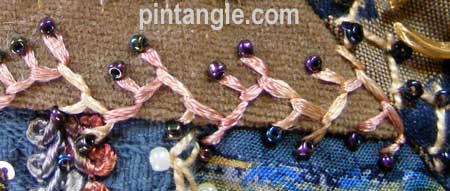
Feather stitch is worked using hand dyed rayon ribbon was worked along the side of patch 5. The tones are a soft warm apricot with sat with the colours in the fabrics on the crazy quilt block. I then added a small seed beads. This seam is quite thick velvet fabric, so I chose a stitch that I could slide under the fabric between the layers, rather than have to stab stitch through two layers. This made the seam easier to stitch, and not so hard on my hands.
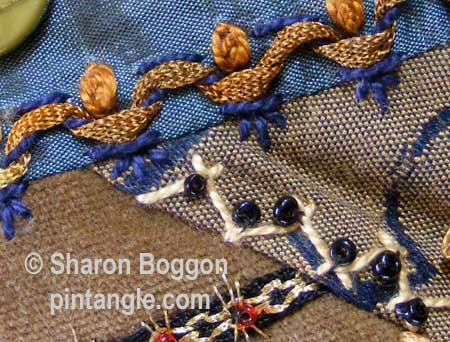
Along the edge of patch 8 I worked a line of Chevron stitch worked in perle #5 cotton. Next I threaded the Chevron stitches with a flat 5mm ribbon knitting yarn. The second detail you can see in this photograph runs along the edge of patch 6 is tied Herringbone stitch worked in perle #5 cotton. Seed beads were added last.
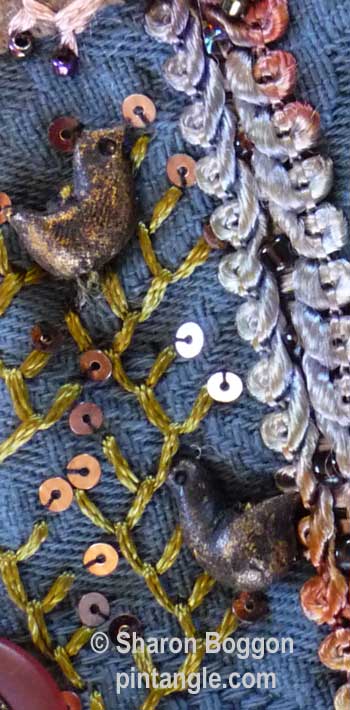
I covered patch 4 Feather stitch using a rayon thread. Next I then added some very tiny vintage sequins that are the same size as a seed bead. The two little bronze coloured novelty beads in the shape of birds were added last.
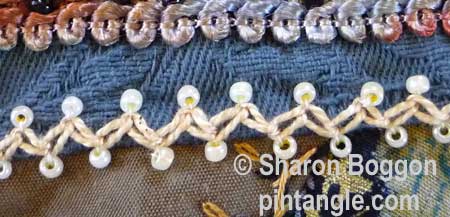
This seam running down the side of patch 4 is covered it with Zigzag Chain Stitch worked in cotton perle #5. I then added small seed beads to the points of each stitch.
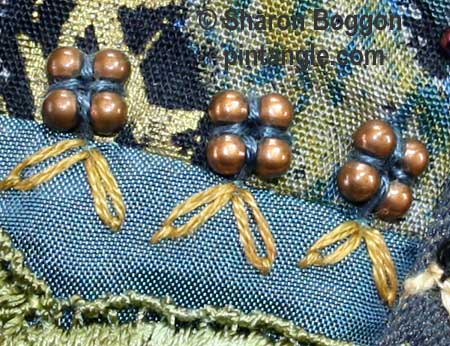
In the middle of the block, along the seam between patch 1 and patch 2 I stitched down 3 copper coloured beads. To the bottom edge of each bead I added two Detached Chain stitches. I used stranded cotton floss.
This series are great to learn crazy quilting techniques, give you ideas on how to embellish your blocks and what stitches to use on your Crazy quilt seams. Each block is documented alongside a free crazy quilt block pattern. With each block I explain which stitches I used to cover the seams and I link to tutorials in my Stitch Dictionary. The technical details are included such as what threads I used, on what type of fabric, dyes used and if applicable I include design notes.
If you want to learn Crazy Quilting here are the links to the free crazy quilt block patterns in the series:
Block 1, Block 2, Block 3, Block 4, Block 5, Block 6, Block 7, Block 8, Block 9, Block 10, Block 11, Block 12, Block 13, Block 14, Block 15, Block 16, Block 17, Block 18, Block 19, Block 20, Block 21, Block 22, Block 23, Block 24, Block 25, Block 26, Block 27, Block 28, Block 29, Block 30, Block 31, Block 32, Block 33, Block 34, Block 35, Block 36, Block 37, Block 38, Block 39, Block 40, Block 41, Block 42, Block 43, Block 44, Block 45, Block 46, Block 47, Block 48, Block 49, Block 50, Block 51, Block 52, Block 53, Block 54, Block 55, Block 56, Block 57, Block 58, Block 59, Block 60, Block 61, Block 62, Block 63, Block 64, Block 65, Block 66, Block 67 Block 68, Block 69, Block 70, Block 71, Block 72 , Block 73, Block 74, Block 75, Block 76, Block 77, Block 78, Block 79, Block 80, Block 81, Block 82, Block 83, Block 84, Block 85, Block 86, Block 87, Block 88, Block 89, Block 90, Block 91, Block 92, Block 93, Block 94, Block 95, Block 96, Block 97, Block 98, Block 99, Block 100
All articles in this series can also be found in the Crazy quilting category and the Crazy quilt details category
If you enjoy this series you may be interested in a tutorial I have written. How to work decorative crazy quilt seams is a comprehensive tutorial converted to a pdf file. When I converted it I realised how comprehensive it was. At 19 pages of information it is a mini ebook and resource worth investigating!
My book on Crazy Quilting
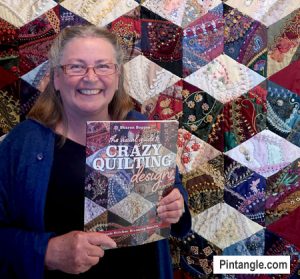
My book The Visual Guide to Crazy Quilting Design: Simple Stitches, Stunning Results shares detailed practical methods about how to design and make a crazy quilt.
From fabric choice, to balancing colour, texture, and pattern, in order to direct the eye around the block. I cover how to stitch, build decorative seam treatments in interesting and creative ways. This book is profusely illustrated as my aim is to be practical and inspiring.
Follow Pintangle and have it delivered to your inbox
You can have Pintangle delivered to your inbox — In the side bar use the Subscribe to Pintangle box or If you are on a mobile scroll to the bottom the of the page to find the Subscribe to Pintangle option. In either case type in your email address and click on the Subscribe button below. Then check your email inbox for a confirmation email and click the link to confirm your subscription. If you don’t see a confirmation email, check your spam folder — sometimes the computer puts it there.
